
Orthognathic surgery: the stages of treatment, from assessment to result
3D assessment, orthodontics before the operation, virtual planning, surgery, then finishing: the complete journey of jaw surgery.
By Dr Afshin Yousefpour, oral and maxillofacial surgeon, Consultant Specialist (UK), FRCSEd · Published on 6 November 2026. See his background
Orthognathic surgery is not just one day in the operating theatre. It is a team treatment, carried out with your orthodontist, that spans several months. Knowing in advance how it works helps you get organised and approach the operation calmly. Here are the stages, in order.
1. The first assessment
Treatment starts with a consultation, often at the request of your orthodontist or dentist. Dr Yousefpour examines your face, your teeth, how wide your mouth opens and your jaw joints. He also asks what bothers you: chewing, breathing, snoring, pain, or how your profile looks.
At Face Clinic in Waterloo, the examinations are done on site:
- a large-field CBCT, a low-dose 3D scan of the whole face;
- a digital impression with the intraoral scanner;
- 3D photographs of the face.
At the end of this assessment, you know whether surgery would help, which jaw is involved (upper, lower or both) and how the treatment will be organised. If you are still wondering whether it applies to you, read Do I need jaw surgery?
2. Orthodontics before the operation (6 to 18 months)
In most cases, your orthodontist fits a fixed brace to align the teeth on each jaw before the operation. The aim is not yet a good bite, but to place the teeth so that both arches fit together perfectly once the jaws have been repositioned.
Sometimes this preparation makes it look as if the bite is getting worse: the teeth's natural compensations are removed, and the bone imbalance becomes more visible. This is normal, and a sign that the preparation is progressing.
The timing of the operation is chosen together by the orthodontist and Dr Yousefpour.
3. Virtual 3D planning
A few weeks before the operation, new examinations are done. The scan, the impressions and the 3D photographs are merged in Dolphin Imaging software to create a virtual copy of your face.
Dr Yousefpour simulates the movements of the jaws to the millimetre, checking at the same time:
- how the teeth fit together;
- the symmetry of the face;
- the effect on the profile, lips and nose;
- the space left for the airway.
Custom surgical splints are then 3D-printed. They make it possible to reproduce this plan accurately in the operating theatre.
4. The operation
| In practice | |
|---|---|
| Duration | 2 to 5 hours, depending on whether one or both jaws are operated on |
| Anaesthesia | General |
| Hospital stay | 1 to 2 nights |
| Scar | None on the face: everything is done from inside the mouth |
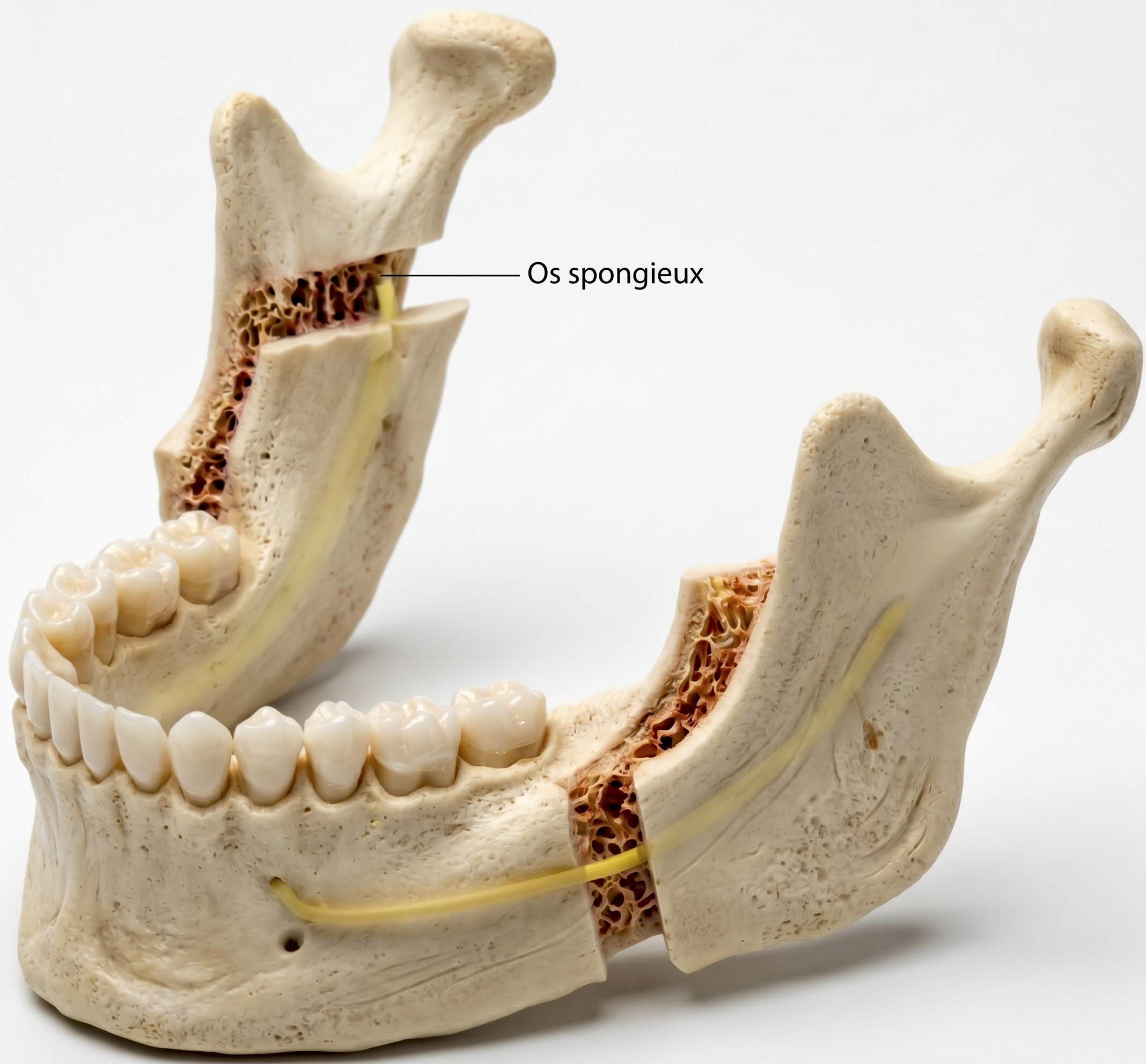
Depending on your situation, Dr Yousefpour performs a Le Fort I osteotomy (upper jaw), a sagittal split osteotomy of the mandible (lower jaw), both (bimaxillary surgery), sometimes combined with a genioplasty (chin). The bones are fixed in their new position with small titanium plates and screws. The jaws are not wired together: light elastic bands guide the bite during healing.
5. Recovery
Swelling is greatest in the first few days, then decreases markedly over the first two weeks. The diet is liquid for 2 weeks, then soft for 2 weeks. Normal activities usually resume after 2 to 3 weeks. We describe this period in detail in the article Recovery after orthognathic surgery, week by week.
6. Orthodontic finishing
Once the bone has healed, your orthodontist resumes treatment to fine-tune how the teeth meet. This phase usually lasts a few months. The brace is then removed and a retainer (a wire bonded behind the teeth or a clear tray) maintains the result.
The journey at a glance
| Stage | Usual duration |
|---|---|
| Assessment and 3D imaging | 1 consultation |
| Orthodontics before the operation | 6 to 18 months |
| Virtual planning and splints | A few weeks before the operation |
| Operation and hospital stay | 2 to 5 hours, 1 to 2 nights |
| Back to normal activities | 2 to 3 weeks |
| Orthodontic finishing | A few months |
Frequently asked questions
Can surgery be done without orthodontics? In some selected cases, part of the orthodontics can be done after the operation. In most cases, orthodontic preparation remains necessary for a stable result. The choice is made case by case with your orthodontist.
From what age? Once jaw growth is complete, usually around 16 to 18 in girls and 18 to 20 in boys. There is no upper age limit: many patients are operated on at 30, 40 or older.
Is the result permanent? The bones are fixed and heal in their new position. The orthodontic retainer and follow-up maintain the result over the long term.
What are the risks? They are explained at the consultation and in the consent form: swelling and bleeding, infection, loss of sensation in the lip, usually temporary, and, more rarely, partial relapse. The form is available in the patient resources.
In summary
- Orthognathic surgery is a team treatment between the orthodontist and Dr Yousefpour.
- Orthodontics prepares the teeth for 6 to 18 months before the operation.
- 3D planning in Dolphin Imaging makes it possible to plan each movement to the millimetre.
- The operation is done from inside the mouth, with no scar on the face.
All the information on the procedure and the before-and-after photos is on the Orthognathic surgery page.
This article is general information. Only a consultation can determine the right treatment for your situation.