

Frenectomy (tongue-tie and lip-tie)
Restoring mouth movement with a precise procedure.
Duration
15 to 30 minutes
Anaesthesia
Gentle local anaesthesia, or sedation / general anaesthesia in hospital
Hospital stay
Day case
Recovery
Lining healed in 7 to 10 days, guided exercises
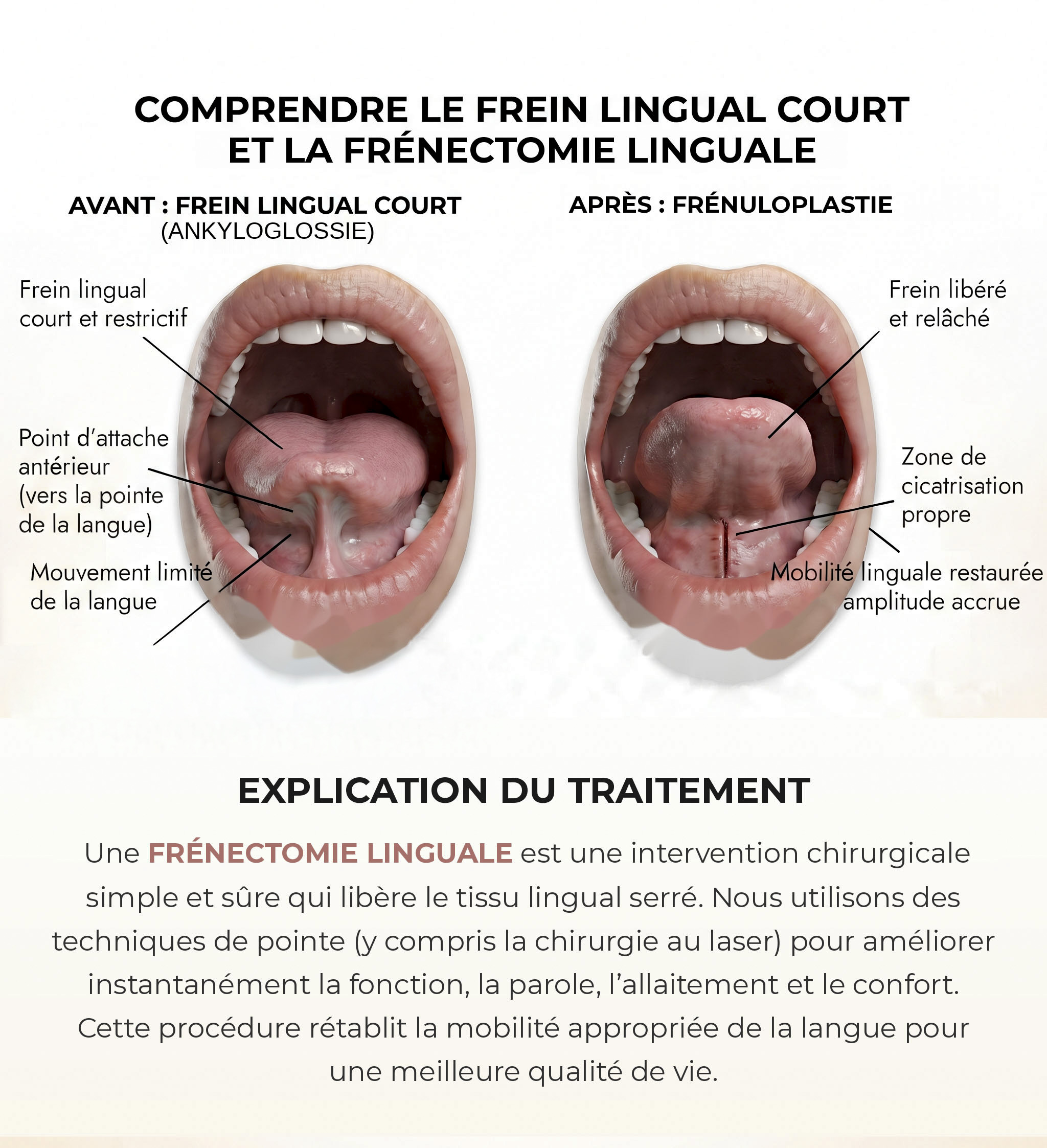
A frenectomy is a minor surgical procedure that modifies or releases an oral frenulum (tongue or lip) that is too short, too thick or too tight. When a frenulum restricts the natural movements of the mouth, it can affect feeding, speech, jaw development or posture.
At the practice, Dr Yousefpour treats this condition in a personalised, comprehensive way, putting your comfort, or your child’s, at the heart of care.
The protocol, step by step.
- Step 1
Initial assessment
Thorough evaluation of mouth movement and functions (sucking, speech, swallowing).
- Step 2
The procedure
Performed under gentle local anaesthesia in a calm, reassuring setting, or under sedation or general anaesthesia in hospital.
- Step 3
Healing follow-up
A check-up to confirm that the tissues are healing well and function is recovering.
Why have a frenectomy?
A restrictive frenulum can disrupt several essential everyday functions:
In babies (tongue-tie): it prevents the tongue from lifting properly, which disrupts sucking. This often shows as breastfeeding difficulties (pain and cracked nipples for the mother, swallowing air, colic) or poor weight gain for the baby.
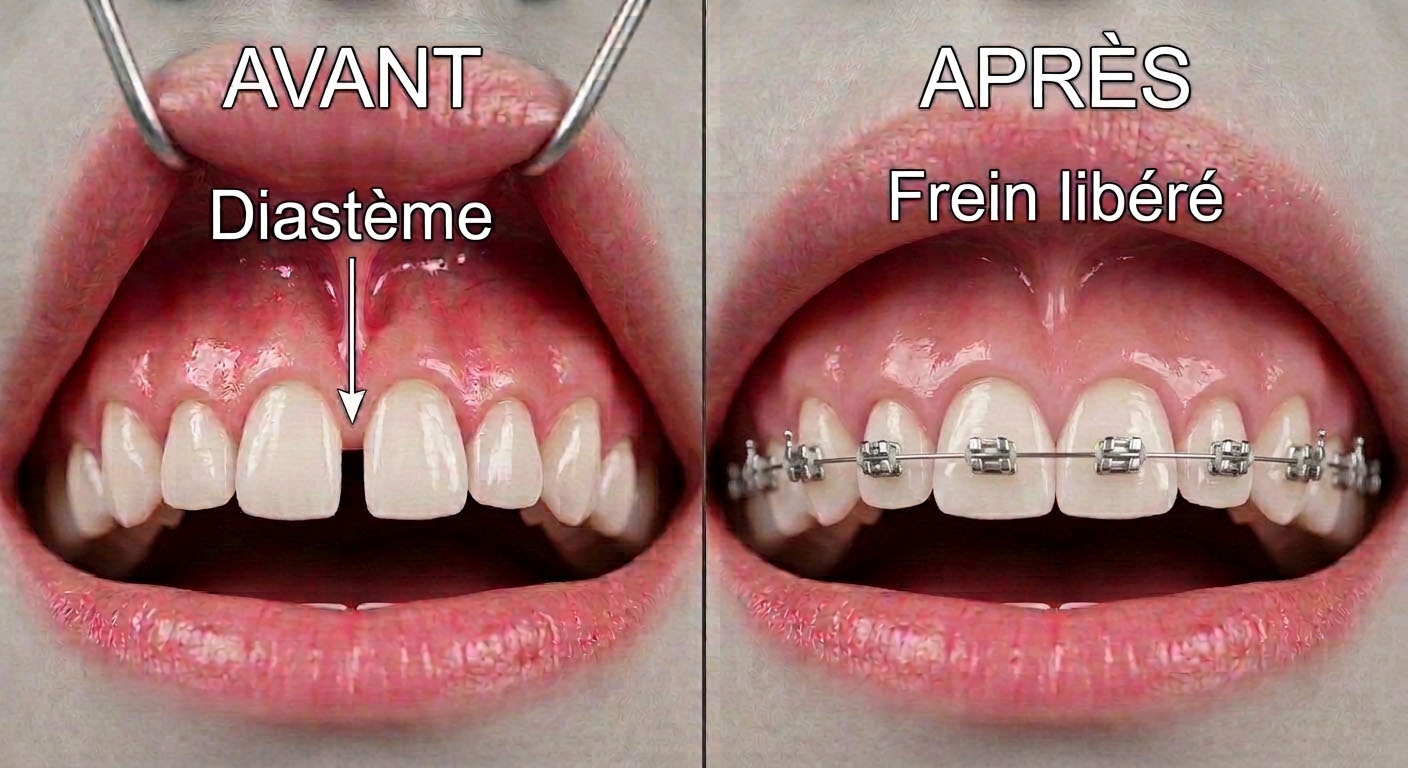
In children and adults (tongue- and lip-tie): a restrictive frenulum can cause speech or swallowing problems. A low lip frenulum can also create a gap between the incisors (diastema) or lead to early gum recession.
Distinctive expertise: a modern, human approach
Choosing Dr Yousefpour for a frenectomy means benefiting from highly specialised know-how built on three pillars.
Advanced laser technology: Dr Yousefpour uses a latest-generation laser for most procedures. Unlike a traditional scalpel, the laser offers great precision with respect for surrounding tissue, an almost painless and very quick procedure, minimal bleeding thanks to instant sealing of the vessels, and noticeably faster healing with less discomfort.
A multidisciplinary approach: a frenulum is not just a piece of tissue to cut. That is why Dr Yousefpour works closely with a network of experts (speech therapists, physiotherapists).
A rigorous follow-up protocol: 50 % of a frenectomy’s success depends on the procedure and 50 % on active healing. Dr Yousefpour will refer you to a speech therapist who will teach you the stretching and rehabilitation exercises needed to guide healing, make the most of the regained movement and prevent the frenulum from reattaching.
The advantages of laser
Instant haemostasis: the beam seals the tiny vessels as it cuts, with no bleeding.
No or far fewer stitches: thermal precision avoids the tension and discomfort of sutures.
Decontaminating and stimulating effect: the area is sterilised in real time and cell regeneration is stimulated.
Post-operative comfort: much less pain and swelling than with a conventional scalpel.
Preserved suppleness: vaporisation prevents stiff, contracting scar bands and keeps the lip mobile.
Frenectomy or frenuloplasty?
Laser frenectomy: vaporisation or precise division of a thickened or restrictive frenulum, to remove the pull on the central incisors (gap closure) or free a restricted tongue.
Laser frenuloplasty: repositioning and advanced tissue plasty (Z-plasty type) for complex anatomy requiring structural lengthening without residual scar tension.
Indications in adults and children
Tongue-tie (ankyloglossia): speech difficulty, limited tongue movement, postural effects or chewing difficulties.
Upper lip frenulum: gap between the front teeth, pulling on the lip when smiling, lip asymmetry, interference with orthodontic treatment.
Lower lip frenulum: pulling that causes gum recession or makes a denture unstable.
Normal recovery and risks
A thin whitish film covers the treated area from the first 24 hours: this is the fibrin membrane typical of laser healing, not an infection. It should not be removed.
Irritation or mild discomfort for 24 to 48 hours, controlled with ordinary painkillers.
Possible moderate temporary swelling within 48 hours.
Exceptional secondary bleeding, possible after direct trauma to the operated area.
Infection extremely rare thanks to the sterilising effect of the laser, prevented by suitable hygiene.
Recurrence or fibrous contraction if the prescribed movement exercises are not done regularly.
Prolonged local sensitivity to hot or acidic food while the lining heals.
Post-operative instructions
Lukewarm or cold, soft, non-irritating food; avoid acidic, spicy, very salty or crunchy food.
Take painkillers as soon as the local anaesthetic starts to wear off, before sensation returns; an ice pack 10 minutes per hour on the first day after a lip procedure.
Resume brushing the same evening with a very soft brush, without firm contact on the site; prescribed mouthwashes from the next day, without gargling or sucking.
Stretching exercises 3 to 4 times a day for 2 to 3 minutes, for 2 weeks: tongue forward, touching the palate with the mouth wide open, sweeping the cheeks; for a lip frenulum, gentle movement of the lip and light facial expressions.
Avoid: smoking and e-cigarettes for at least 7 days, alcohol for 48 hours, strenuous exertion for 48 hours and using a straw.