
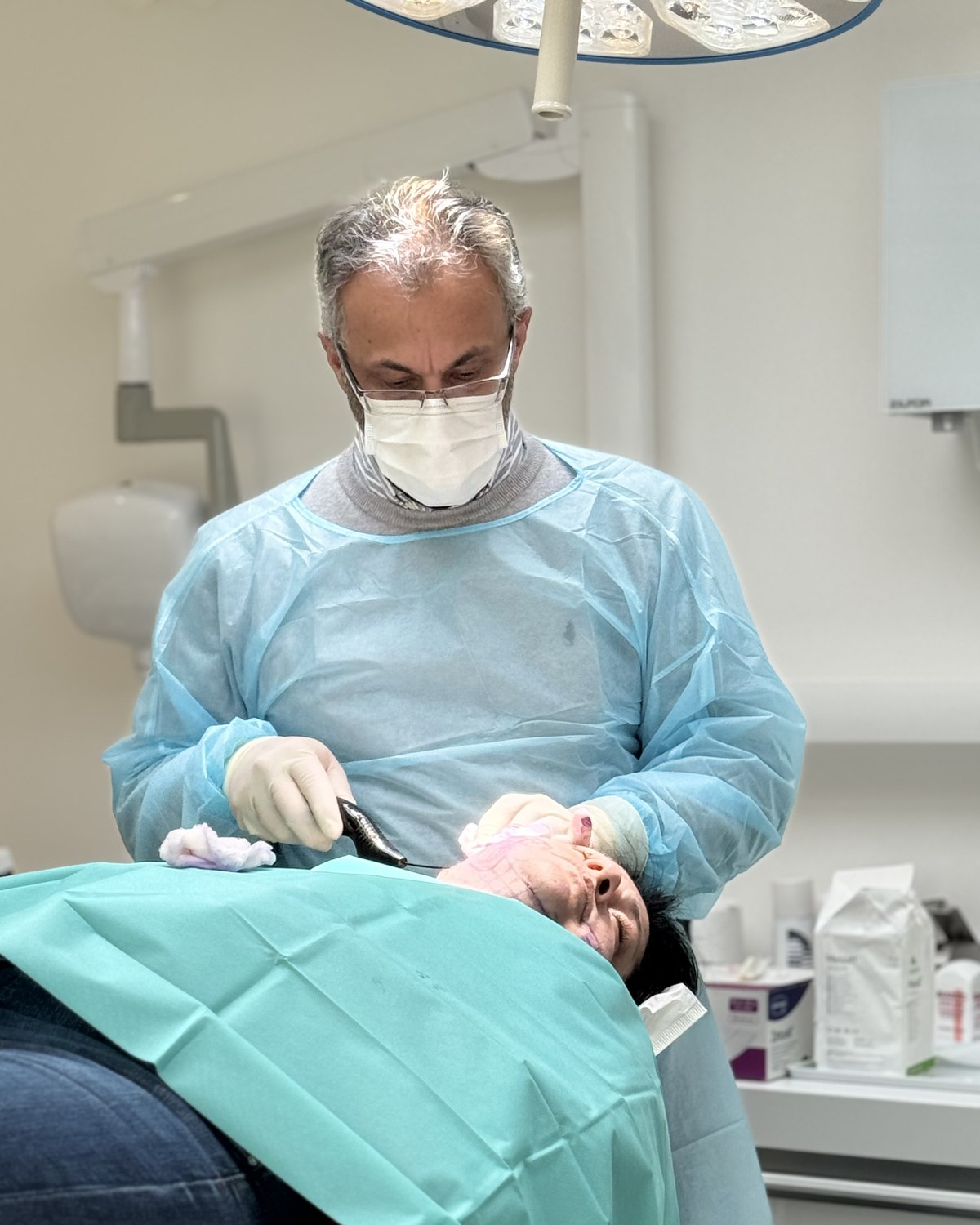
Orthognathic surgery: a treatment carried out together.
With more than 25 years of jaw surgery, Dr Afshin Yousefpour, maxillofacial surgeon in Waterloo, near Brussels, works closely with orthodontists at every stage of combined orthodontic-surgical treatment: initial assessment, timing of surgery, 3D planning and post-operative follow-up.
A surgeon who operates to serve your goals.
In orthognathic surgery, the orthodontist prepares the arches, the surgeon repositions the jaws, then the orthodontist completes the finishing. The result depends on the quality of this collaboration. Dr Yousefpour discusses the indication, the timing of surgery and the planned movements with you, and keeps you informed at every stage.
The practice is fully digital: a large-field CBCT, an intraoral scanner and 3D facial photography allow a complete assessment on site. Every operation is then planned entirely digitally by Dr Yousefpour himself, using the Dolphin Imaging orthognathic planning software.
More than 25 years of jaw surgery.
Dr Yousefpour qualified in stomatology in Brussels in 1997 and completed full training in oral and maxillofacial surgery in the United Kingdom, where he was appointed Consultant Specialist in 2006. A Fellow of the Royal College of Surgeons of Edinburgh (FRCSEd), he has performed orthognathic surgery for more than 25 years: Le Fort I, sagittal split osteotomies, bimaxillary surgery, genioplasty and palatal expansion.
Where indicated, he uses piezosurgery (ultrasound) for selective bone cutting that protects the inferior alveolar nerve and the soft tissues.
Every operation planned on Dolphin Imaging.
Before each operation, the CBCT, the intraoral scans and 3D facial photography are merged in Dolphin Imaging. Dr Yousefpour performs the cephalometric analysis, simulates the movements of the maxilla, mandible and chin, and anticipates the response of the soft tissues and profile.
This plan is the basis of our discussion with you: the planned movements are checked against your occlusal goals before surgery. The surgical splints are then 3D-printed to reproduce the plan precisely in the operating theatre.
What you can refer to us.
Orthognathic surgery
Le Fort I osteotomy, bilateral sagittal split osteotomy, bimaxillary surgery: class II and III, open bite, vertical excess, asymmetry.
Transverse expansion
Surgically assisted rapid palatal expansion (SARPE) and miniscrew-assisted expansion (MARPE) for narrow palates.
Genioplasty
Advancing, setting back, lowering or centring the chin, alone or combined with jaw surgery.
Impacted canines
Surgical exposure and bonding of an attachment for orthodontic traction.
Wisdom teeth and extractions
Removal of wisdom teeth and extractions for orthodontic purposes.
Frenectomy
Labial or lingual frenula preventing closure of a diastema or limiting tongue movement.
Four stages, coordinated with you.
Step 1
Joint initial assessment
The patient is seen in consultation in Waterloo. The practice has a large-field CBCT, an intraoral scanner and 3D facial photography on site: imaging is done on the same day.
Step 2
Decision and timing
The surgical indication, the goals of orthodontic preparation and the timing of surgery are decided together with you.
Step 3
Virtual 3D planning
Digital planning on Dolphin Imaging: merging of CBCT, intraoral scans and 3D photography, simulation of the bone movements and 3D-printed surgical splints, in line with your occlusal goals.
Step 4
Surgery and follow-up
Surgery in hospital, then post-operative follow-up by Dr Yousefpour himself, coordinated with you: you resume orthodontic finishing and retention.
Your patients supported from the first consultation to the last check-up.
The surgeon who sees your patient is the one who operates and follows them up, with no intermediary.
Before surgery: a consultation dedicated to informed consent, presentation of the 3D simulations, a detailed written document and guaranteed time to reflect.
Preparation: written instructions on the hospital stay, diet and recovery.
After surgery: regular post-operative check-ups with Dr Yousefpour, gentle mouth-opening exercises and monitoring of sensation.
Throughout the pathway: the patient can reach the practice by WhatsApp message, and you are kept informed of the key stages.
Referring a patient.
Send a WhatsApp message to the practice, or give your patient a referral letter: they will book in the same way. To prepare the first consultation, it is helpful to include:
A letter setting out your diagnosis and the goal of treatment.
If available: lateral cephalogram, panoramic radiograph, photographs and digital impressions (STL files).
The stage of orthodontic preparation: before treatment starts, during decompensation, or arches ready for surgery.
Who operates on your patients?
- Surgeon
- Dr Afshin Yousefpour, oral and maxillofacial surgeon
- Consultations
- Face Clinic, 406 Chaussée de Bruxelles, 1410 Waterloo (Belgium)
- Hospital practice
- CHIREC group hospitals: Braine-l’Alleud – Waterloo, Delta (Brussels), Sainte-Anne Saint-Rémi (Anderlecht)
- Training
- Stomatology degree in Brussels (1997), full higher surgical training in oral and maxillofacial surgery in the United Kingdom
- Titles
- Consultant Specialist in oral and maxillofacial surgery (United Kingdom, 2006), FRCSEd
- Experience
- More than 25 years of facial and jaw surgery
- Planning
- Digital planning of every operation on Dolphin Imaging, 3D-printed splints