

Dental implants
Replacing one or more teeth, with bone grafting when needed.
Duration
45 minutes to 2 hours
Anaesthesia
Local, sedation possible
Hospital stay
Day case
Recovery
Osseointegration: 3 to 6 months
A missing or damaged tooth is not only an aesthetic problem: it upsets the balance of your whole oral health. A dental implant is today the most modern, reliable and lasting way to regain a complete, functional and natural smile.
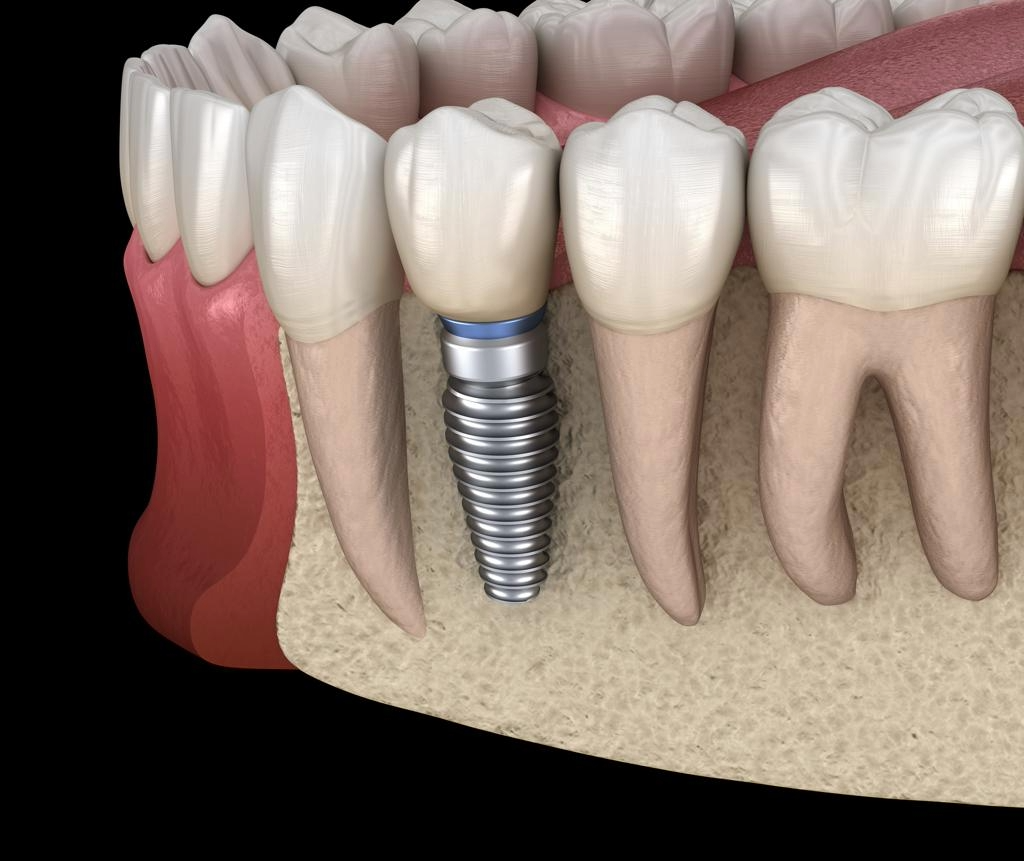
A dental implant is an artificial root, usually made of titanium or zirconia, gently inserted into the jaw bone during a minimally invasive, painless procedure. It fuses naturally with the bone (osseointegration) to form a solid foundation; the crown screwed or cemented onto it reproduces the shape, colour and function of your natural tooth.
The Waterloo practice welcomes patients from Brussels, Braine-l’Alleud and across Walloon Brabant.
The loss of one or more teeth, combined with bone loss, calls for a high-precision surgical approach. Dr Yousefpour has chosen to use the most advanced digital technology to turn complex cases into predictable, safe and less invasive procedures.
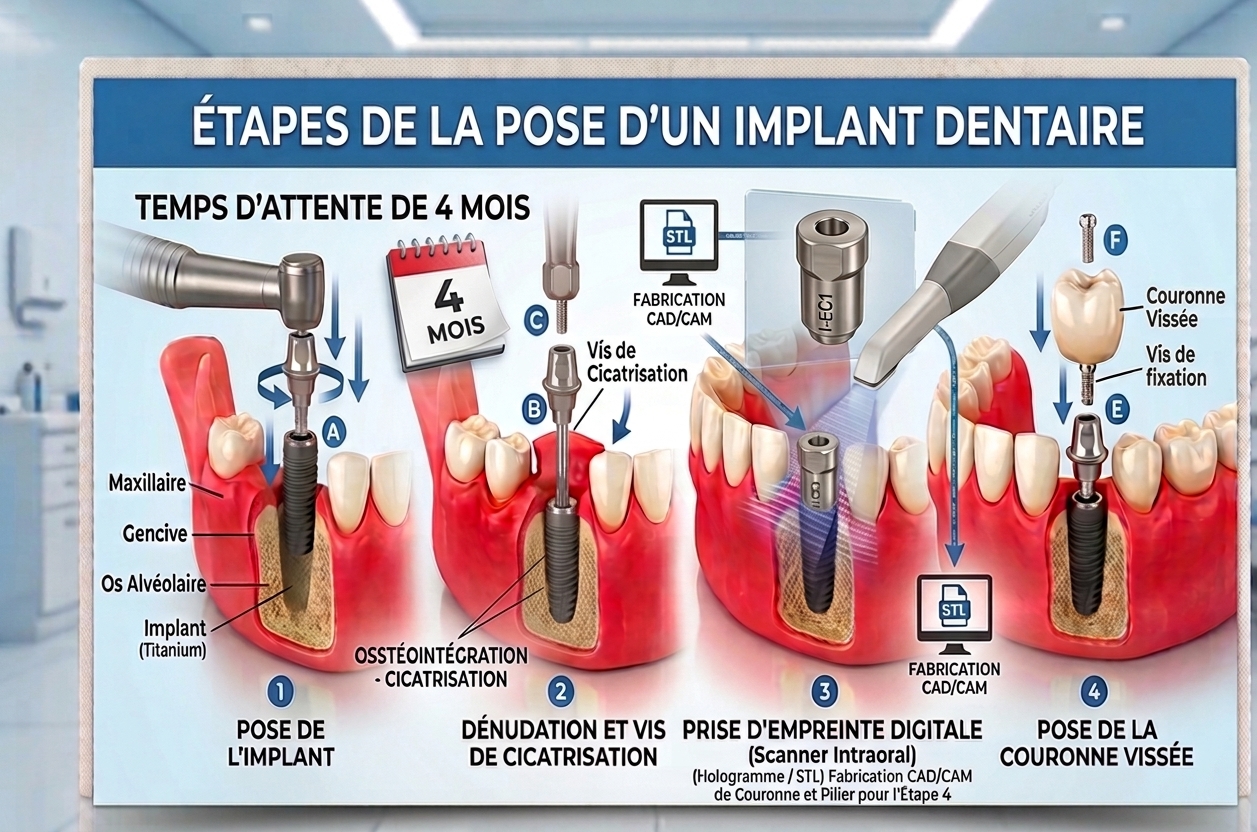
The protocol, step by step.
- Step 1
Pre-implant assessment
In-depth clinical consultation, advanced imaging (cone beam / CBCT) and a digital impression for tailored 3D planning of the placement.
- Step 2
Bone preparation if needed
Particulate or block bone grafting, or a sinus lift, when the bone volume is not sufficient for lasting anchorage.
- Step 3
Implant placement
Procedure under local anaesthesia, with sedation if needed, under strict sterile conditions, with guided surgery or X-Guide dynamic navigation.
- Step 4
Healing, then the prosthesis
A few months of osseointegration, with a temporary tooth possible for appearance, then fabrication and fitting of the permanent crown.
More than 25 years’ experience for your implants
Qualified in stomatology in Brussels in 1997, Consultant Specialist in oral and maxillofacial surgery in the United Kingdom since 2006 and a Fellow of the Royal College of Surgeons of Edinburgh (FRCSEd), Dr Afshin Yousefpour places implants in straightforward situations as well as complex cases where bone is lacking.
Patient safety comes first. Every treatment is planned in 3D, the least invasive technique is preferred and everything is done to reduce complications and discomfort, from preparation to the follow-up of healing.
Why choose dental implants?
Comfort and appearance: they blend in perfectly with your teeth, with no visible difference.
Preserving neighbouring teeth: unlike a traditional bridge, an implant does not require healthy adjacent teeth to be drilled down.
Bone health: the implant stimulates the jaw bone and prevents the bone loss caused by missing teeth.
Longevity: with good oral hygiene and regular follow-up, it is a solution designed to last a lifetime.
Advanced implantology: guided surgery and dynamic navigation
Virtual planning: before the procedure, data from the NewTom scanner and the digital impressions are merged to simulate the ideal position of the implants.
Surgical guide: it acts like a “GPS” during the operation, ensuring an optimal position while respecting the bone volume and key anatomical structures.
X-Guide dynamic navigation: for the most demanding situations, this navigation system shows on screen the exact position of the drill relative to the 3D plan, moment by moment.
Precision and flexibility: high accuracy even in the tightest sites, with immediate adjustment during the procedure.
Bone reconstruction: controlled sinus lift to increase bone height in the back of the upper jaw, and particulate or block bone grafts to rebuild a solid, lasting foundation.
Indications and clinical situations
Replacing a single tooth: an aesthetic, stand-alone solution.
Replacing several teeth: multiple implants or implant-supported bridges to avoid a removable denture.
Full-arch rehabilitation: fixed solutions such as All-on-4 or All-on-6 to regain a complete fixed jaw in a short time.
Bone grafts and sinus lift: guided bone regeneration or sinus elevation when bone volume is lacking.
Severely resorbed upper jaw: zygomatic implants using the extra-sinus technique, anchored in the cheekbone without passing through the sinus cavity, when bone reconstruction is not desirable or not possible.
Expected benefits and success rate
Modern implantology has a very high success rate, estimated at 95 % to 98 %. It effectively restores chewing, speech and the appearance of the smile, with everyday comfort.
Every patient is unique: at the first consultation, a full assessment including 3D imaging makes it possible to define with you the solution best suited to your functional and aesthetic needs.
Potential risks and complications
Temporary local effects: swelling, bruising, moderate pain or discomfort at the surgical site, difficulty opening the mouth.
Risk of infection: a local infection may occur and requires suitable antibiotic treatment.
Failure of osseointegration: in rare cases (around 2 to 5 %), the implant does not fuse properly with the bone. It is then removed, and a new attempt or an alternative solution can be considered after healing.
Exceptional anatomical complications: injury to nearby nerves, causing temporary or, more rarely, lasting numbness of the lip or chin, or involvement of the maxillary sinus; these are carefully prevented by prior 3D imaging.
Factors that increase the risk
Active smoking, which markedly reduces blood supply and the success rate.
Insufficient oral hygiene.
Certain uncontrolled general conditions: uncontrolled diabetes, severe osteoporosis, immunosuppressive treatment.
Maintenance remains essential: careful brushing, interdental brushes and annual check-ups.
Your information and your consent
Every operation, including the placement of dental implants, requires clear and honest information. As an oral and maxillofacial surgeon, Dr Yousefpour undertakes to answer all your questions so that you can make an informed decision.
The goals and expected benefits of implant treatment.
The various possible alternatives.
What happens before and after the procedure, and the associated risks.
Frequently asked questions
Why have implants placed by a maxillofacial surgeon?
A maxillofacial surgeon is trained in the full anatomy of the jaws, from the inferior alveolar nerve to the maxillary sinus. He can place implants even when bone is lacking, thanks to bone grafting, a sinus lift or zygomatic implants. Dr Yousefpour brings more than 25 years of facial and jaw surgery to implantology.
Is having an implant placed painful?
The procedure is performed under local anaesthesia, with sedation if needed. After placement, swelling and moderate discomfort are common for a few days and are controlled with suitable medication.
What if I do not have enough bone?
A bone graft or sinus lift rebuilds the necessary volume before or during placement. For a severely resorbed upper jaw, zygomatic implants using the extra-sinus technique can avoid major reconstruction.
How long does it take to get a permanent tooth?
Osseointegration of the implant usually takes 3 to 6 months, with a temporary tooth possible for appearance. The permanent crown is fitted afterwards.
What is the success rate of dental implants?
The success rate is estimated at 95 % to 98 %. Smoking, poor oral hygiene and certain uncontrolled conditions increase the risk of failure; careful maintenance and annual check-ups remain essential.
How is the placement made safe?
Each implant is planned in 3D from a CBCT scan and digital impressions. Placement is guided by a surgical guide or by X-Guide dynamic navigation, to respect the bone and sensitive structures such as the nerve and the sinus.