

Wisdom teeth
Removal of impacted or troublesome third molars.
Duration
30 to 90 minutes
Anaesthesia
Local, intravenous sedation or general
Hospital stay
Day case (a few hours’ monitoring after general anaesthesia)
Recovery
Plan a week off
Wisdom teeth are the last teeth to come through at the back of the mouth, at the end of adolescence.
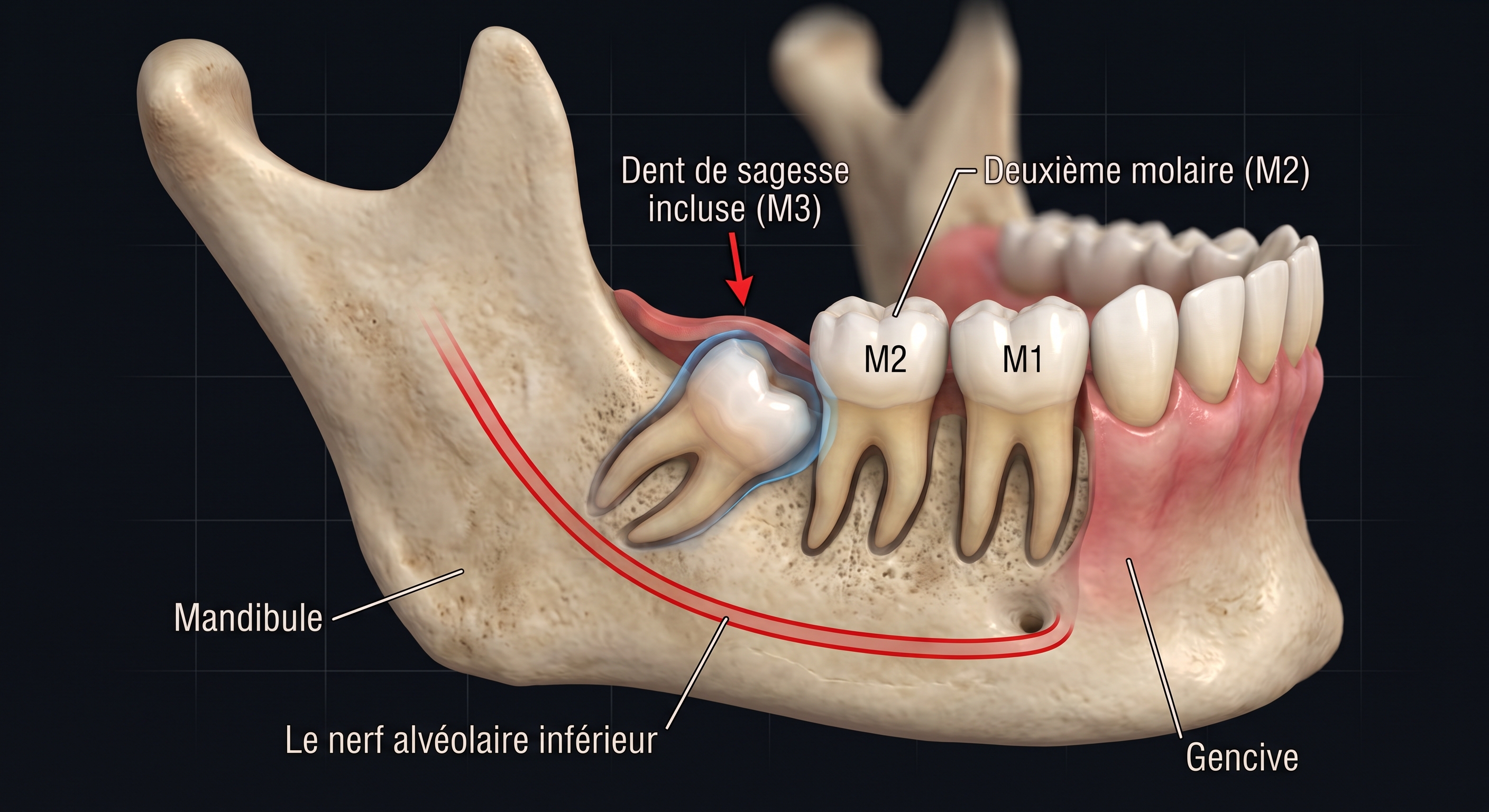
When there is not enough space, some wisdom teeth cannot come through and become stuck in the jaw against the second molars. They are then called impacted wisdom teeth.
As a maxillofacial surgeon, Dr Yousefpour removes impacted wisdom teeth with latest-generation techniques, in particular piezosurgery (ultrasound), which allows precise bone cutting while limiting the risk of injury to the inferior alveolar nerve. Many orthodontists therefore refer their patients to him for the removal of impacted wisdom teeth.
The protocol, step by step.
- Step 1
Assessment and choice of anaesthesia
Dr Yousefpour discusses the options with you and recommends the best form of anaesthesia according to the surgical difficulty, the number of teeth to remove and your wishes.
- Step 2
Incision and exposure
An incision in the gum exposes the bone covering the tooth, then this bone is removed to reach the impacted tooth, using ultrasonic piezosurgery instruments that spare the soft tissues and the nerve when needed.
- Step 3
Extraction
If needed, the crown and roots are sectioned before removal, to limit trauma.
- Step 4
Closure
The wound is closed with a few dissolvable stitches, which disappear on their own within three weeks.
Why remove a wisdom tooth?
A severe infection or repeated infections (pericoronitis): pain or swelling of the gum partly covering the impacted tooth, sometimes with swelling of the cheek and face, or even painful limitation of mouth opening.
Decay affecting the impacted wisdom tooth or the molar it is stuck against.
A wisdom tooth growing towards the cheek and causing irritation and inflammation.
Before surgery to move the jaw forward or back, so that it can be performed with less risk.
A stuck, impacted tooth can lead to poor oral hygiene and cause gum disease.
A cyst associated with the impacted tooth.
An associated tumour.
Lack of space, when your dentist or orthodontist needs to create room to align your teeth, reduce the risk of relapse at the end of orthodontic treatment, or because these teeth may disturb alignment.
A jaw fracture with the impacted tooth in the fracture line: removal then makes proper reduction easier.
Who should remove your wisdom teeth?
Wisdom tooth removal is one of the first procedures a stomatologist is trained in: it is a cornerstone of oral surgery. Dr Yousefpour’s career started with this stomatology training, completed in Brussels in 1997, and continued with full training in oral and maxillofacial surgery in the United Kingdom.
This dual training comes into its own with an impacted wisdom tooth. It is no longer just a matter of removing a tooth, but of operating in the jaw bone, right next to the inferior alveolar nerve, the maxillary sinus and the neighbouring roots. The maxillofacial surgeon knows this anatomy as a whole and manages any after-effects: an associated cyst, a root fragment, a communication with the sinus or a fracture.
This is also why dentists and orthodontists refer the most delicate extractions to Dr Yousefpour, particularly impacted teeth and those close to the nerve.
More than 25 years’ experience for your wisdom teeth
Since qualifying in stomatology in Brussels in 1997, wisdom tooth removal has been part of Dr Afshin Yousefpour’s practice. It accompanied him throughout his surgical training in the United Kingdom, up to his appointment as Consultant Specialist in oral and maxillofacial surgery in 2006.
This long, international experience allows him to anticipate difficult situations: deeply impacted teeth, roots touching the nerve, upper teeth close to the sinus or teeth associated with a cyst. Each case is assessed individually to choose the safest and least traumatic approach.
Stomatology degree in Brussels (1997): wisdom tooth surgery is at the heart of this training.
Consultant Specialist in oral and maxillofacial surgery in the United Kingdom (2006).
Fellow of the Royal College of Surgeons of Edinburgh (FRCSEd).
Patients referred by dentists and orthodontists for delicate extractions.
Minimally invasive surgery and patient safety: the priority at every step
Patient safety guides every decision Dr Yousefpour makes. His aim is twofold: to minimise the risk of complications and to make recovery as simple and comfortable as possible.
To do so, he favours minimally invasive techniques that remove as little bone as possible and spare the gum, muscles and nerves. In particular cases, such as a deeply impacted tooth, roots touching the inferior alveolar nerve or an upper tooth close to the sinus, he uses piezosurgery.
Piezosurgery uses ultrasonic micro-vibrations that cut bone selectively while preserving the soft tissues, vessels and nerve. The cut is more precise and less traumatic than with conventional rotary instruments, which helps limit swelling, pain and the risk of nerve injury.
Rigorous pre-operative assessment: clinical examination, panoramic X-ray and, if needed, 3D imaging (CBCT) to locate the tooth precisely relative to the nerve and the sinus.
Choice of the least invasive technique: piezosurgery where warranted, sectioning the tooth to avoid forcing the bone, or coronectomy when the roots touch the nerve.
Anaesthesia suited to each patient: local, intravenous sedation or general, depending on the difficulty, the number of teeth and the patient’s anxiety.
Techniques designed to limit after-effects: small incisions, bone preservation, careful rinsing of the site and dissolvable stitches.
Prevention and post-operative follow-up: suitable pain-relief and anti-inflammatory treatment, clear written instructions and a check of healing, with access to the practice for any question or concern.
Teamwork with your dentist and orthodontist
For Dr Yousefpour, wisdom tooth removal is part of a shared care pathway. The dentist and orthodontist who look after you know your mouth, your treatment and your expectations: working hand in hand with them is an integral part of quality and safety of care.
He has long-standing relationships of trust with the dentists and orthodontists who refer patients to him, particularly for impacted teeth or teeth close to the nerve. This team spirit makes it possible to decide together on the right time for the extraction, fit it into the orthodontic treatment plan and ensure continuity of follow-up after the procedure.
Discussion with the referring practitioner before the procedure: reason for referral, available X-rays and treatment goals.
Coordination with the orthodontist: timing the extraction to create space, ease alignment or limit the risk of relapse at the end of treatment.
An operative report sent to the dentist or orthodontist, so that they have all the information needed for follow-up.
Return to your usual practitioner once healing is complete, respecting your relationship with them.
Advanced techniques for impacted wisdom teeth
Lower wisdom teeth often lie very close to the inferior alveolar nerve, which provides sensation to the lower lip and chin. Dr Yousefpour uses advanced techniques to minimise the risk of injury to this nerve and the trauma to the tissues.
3D imaging (CBCT) when indicated: precise location of the tooth and its roots relative to the nerve before the procedure.
Piezosurgery (ultrasound): selective bone cutting that spares the soft tissues, vessels and nerve, for less traumatic surgery.
Controlled sectioning of the tooth: the crown and roots are separated so they can be removed without forcing the bone or the nerve.
Coronectomy when preferable: removing only the crown if the roots are in contact with the nerve.
Collaboration with orthodontists: many orthodontists refer their patients to Dr Yousefpour for impacted wisdom tooth removal, notably to create space or limit the risk of relapse at the end of treatment.
Are there alternatives to extraction?
Painkillers and anti-inflammatories such as paracetamol or ibuprofen help control the swelling and pain. Antibiotics and mouthwashes (povidone-iodine or chlorhexidine) are indicated in case of infection. These are temporary, symptomatic treatments that do not address the cause.
If the root of the wisdom tooth lies right next to the inferior dental nerve, it is possible to remove only the crown of the impacted tooth (coronectomy) to reduce the risk of altered sensation, which can range from mild tingling to complete, temporary or permanent, loss of sensation in the lower lip.
What complications can occur?
Pain: its intensity varies with the surgical difficulty and the drilling around the tooth. A cold pack is advised at least on the first day to reduce swelling and relieve pain; painkillers and anti-inflammatories are prescribed.
Bleeding: place a sterile gauze at the back of the mouth on the wound and bite firmly for about half an hour to help a clot form. Avoid spitting or rinsing, and hot food, for the first 24 hours.
Swelling and bruising: more common with lower wisdom teeth and often related to the difficulty of the operation.
Infection: pain and swelling usually improve after a few days. With an infection, the painful swelling persists beyond 4 to 5 days and worsens; a painful lump may be felt and mouth opening may become limited. Antibiotics are then indicated, with close follow-up.
Dry socket (alveolar osteitis): the blood clot is the best dressing for the wound. Dry socket occurs when this clot is dislodged, exposing the bone. It is extremely painful and develops after about two days; the risk is higher in smokers.
Altered sensation of the lower lip: rarely, during a very difficult extraction and especially when the tooth is very close to the inferior alveolar nerve, accidental nerve damage can occur (from mild tingling to complete loss of sensation), temporarily or permanently. It is then sometimes better to leave a small root fragment in place; very often the bone heals around it and incorporates it.
Loss of a filling, a tooth fracture or a loosened crown remain possible; these mainly concern the teeth just in front of the wisdom teeth.
Oro-antral communication: when removing an upper wisdom tooth, an opening can form between the maxillary sinus (the air-filled cavity above the upper jaw) and the mouth, with a risk of sinusitis, pain and fluid passing between mouth and nose. The opening usually closes on its own, but surgical closure may be needed.
Displacement of the tooth or roots into the maxillary sinus: during a difficult extraction, a tooth may move into the sinus and need surgical removal.
Jaw fracture: very rare, it can occur when removing a deeply impacted tooth and require reduction held with wires, plates and screws.
Limited mouth opening: more common after removal of lower wisdom teeth; opening improves gradually over the following weeks.
What happens after the extraction?
After general anaesthesia, you go to the recovery room and then to your room, where you stay a few hours to make sure there are no complications. A responsible adult must then accompany you and stay with you for at least 24 hours.
If there is bleeding, bite on a gauze for at least 10 minutes. Depending on the difficulty of the procedure and the risk of infection, antibiotics may be prescribed, along with a painkiller (paracetamol), an anti-inflammatory (ibuprofen) and a mouthwash (chlorhexidine or povidone-iodine). Do not smoke and keep your mouth as clean as possible to reduce the risk of infection.
After surgical extraction, the face may be swollen and painful for several days, with limited mouth opening. A soft, semi-liquid diet is recommended until chewing is comfortable again, and physical exercise should be avoided during this period.
As a rule, plan for a week off: without complications, normal activities can resume after that.
Frequently asked questions
Why have wisdom teeth removed by a maxillofacial surgeon?
An impacted wisdom tooth sits in the jaw bone, often close to the inferior alveolar nerve or the maxillary sinus. Dr Yousefpour, who qualified in stomatology in Brussels in 1997 and became Consultant Specialist in oral and maxillofacial surgery in the United Kingdom in 2006, knows this anatomy as a whole and manages difficult situations and any after-effects.
How long does wisdom tooth removal take?
Usually 30 to 90 minutes, depending on the number of teeth, their position and the surgical difficulty. It is a day-case procedure.
Is it done under general anaesthesia?
Removal can be done under local anaesthesia, intravenous sedation or general anaesthesia. The choice is discussed in consultation according to the difficulty, the number of teeth and your wishes.
How is the risk of nerve injury reduced?
3D imaging (CBCT) locates the tooth relative to the nerve when indicated. Ultrasonic piezosurgery allows selective bone cutting, the tooth can be sectioned so it is removed without force, and a coronectomy is offered when the roots touch the nerve.
What is piezosurgery and when is it used?
Piezosurgery is a minimally invasive technique that cuts bone with ultrasonic micro-vibrations, sparing the gum, vessels and nerves. Dr Yousefpour uses it in the particular cases that warrant it, such as a deeply impacted tooth or one close to the nerve, for a more precise procedure and often a lighter recovery.
How are complications and discomfort reduced?
Through careful prior assessment (3D imaging if needed), choice of the least invasive technique, a procedure that preserves bone and protects the nerve, suitable anaesthesia, then treatment and precise post-operative instructions with follow-up of healing. No surgery is risk-free, but everything is done to limit risks.
Can my dentist or orthodontist refer me to Dr Yousefpour?
Yes. Dr Yousefpour works with many referring dentists and orthodontists. He liaises with them before the procedure, coordinates the timing of the extraction with orthodontic treatment and sends them a report to ensure continuity of care.
How many days off should I plan?
As a rule, plan for a week. Swelling, pain and limited mouth opening are common for the first few days; the stitches are dissolvable and disappear within three weeks.
Is wisdom tooth removal reimbursed?
Wisdom tooth removal is a functional procedure that qualifies for reimbursement by the Belgian health insurance funds (mutualités). The costs are given to you in writing before any decision.
Where can I be seen for my wisdom teeth?
Dr Yousefpour consults at Face Clinic in Waterloo, easily reached from Brussels, Braine-l’Alleud and Walloon Brabant, and at the CHIREC hospitals listed on the Contact page. Your dentist or orthodontist can also refer you directly.