
Parotid tumour and parotidectomy
Removing the tumour safely, protecting the facial nerve and reconstructing the parotid defect.
Duration
1 to 3 hours
Anaesthesia
General anaesthesia
Hospital stay
Usually 1 night
Recovery
Back to activities after 10 to 14 days
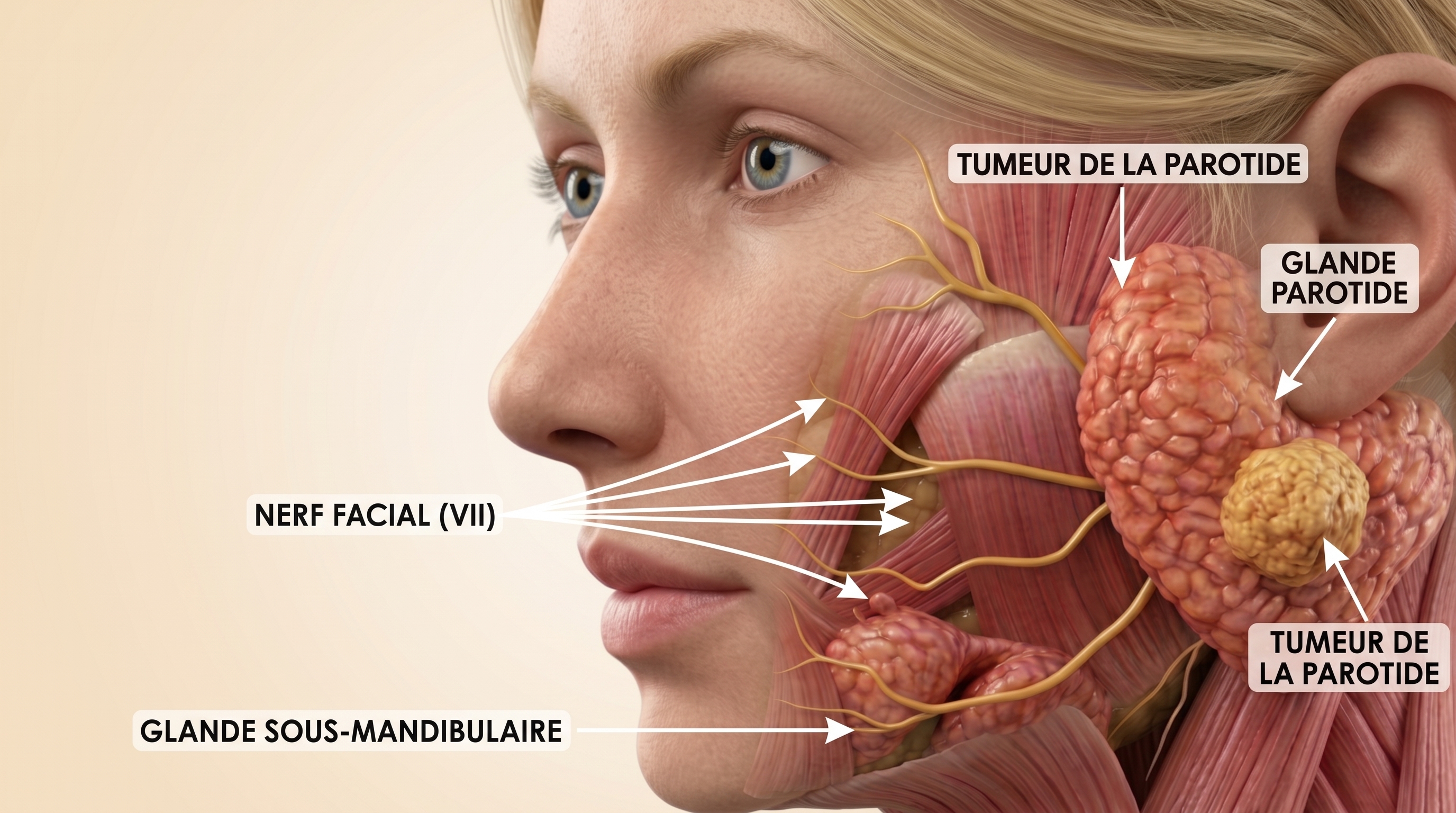
A lump in front of the ear or at the angle of the jaw can be the sign of a tumour of the parotid, the largest salivary gland. Most of these tumours are benign, but their surgery remains delicate because the facial nerve, which controls facial expression, runs through the gland.
Dr Afshin Yousefpour has unique expertise in Belgium in the management of parotid tumours. He combines two skills: removing the tumour safely, thanks to his in-depth knowledge of the parotid and the facial nerve, and reconstructing the defect left by the excision to preserve the contour of the face.
The protocol, step by step.
- Step 1
Advanced imaging
MRI or ultrasound to define the tumour and determine its position in the gland and in relation to the facial nerve.
- Step 2
Tumour analysis
Fine-needle aspiration when needed, to tailor the operation to the type of tumour.
- Step 3
Parotidectomy
Removal of the tumour through a facelift-type incision, with identification and preservation of the facial nerve branches under monitoring and optical magnification.
- Step 4
Reconstruction and follow-up
Filling of the parotid defect, analysis of the specimen and follow-up of healing.
Why see Dr Yousefpour for a parotid tumour?
Parotidectomy is one of Dr Yousefpour’s major areas of expertise. His long experience of this operation was gained in particular in the head and neck oncology and reconstruction teams he led in the United Kingdom.
His approach brings together, in one surgeon, three skills: dissection of the facial nerve, reconstruction of the parotid defect and the techniques of facial aesthetic surgery.
Parotid tumours
Indications: benign parotid tumours (pleomorphic adenoma, Warthin’s tumour / cystadenolymphoma), malignant tumours, chronic sialadenitis or parotid cysts.
Pleomorphic adenoma: the most common benign tumour of the parotid, which grows slowly and can become large.
Malignant tumours: rarer, they require tailored management, decided after a full assessment.
Removing the tumour safely: parotidectomy
The operation removes part of the gland (superficial or partial parotidectomy) or the whole gland, depending on the extent and nature of the lesion. Removing a parotid tumour means first separating it from the facial nerve, identifying each branch in order to protect it.
Dr Yousefpour’s particular expertise: continuous facial nerve monitoring (NIM neuromonitoring) combined with magnification under surgical loupes to identify, dissect and preserve each motor nerve branch individually. A facelift-type incision (modified Redon or peri-auricular incision) hides the scar in natural creases and the hairline, combined with filling of the gland defect to avoid a post-operative hollow of the cheek.
Recovery: moderate swelling of the parotid area for 1 to 2 weeks; a suction drain is common and is removed after 24 to 48 hours; numbness of the earlobe is common and temporary, for a few months; back to usual activities after 10 to 14 days.
Possible complications: temporary facial weakness due to the delicate handling of the nerve (spontaneous recovery in the vast majority of cases within a few weeks to a few months), localised haematoma or seroma, temporary salivary fistula, Frey’s syndrome (sweating of the skin when chewing, rare and treatable).
Reconstructing the parotid defect: an essential step
After excision, the space left by the tumour and the gland can hollow the cheek in front of the ear. For Dr Yousefpour, reconstruction of this defect is an integral part of the operation, given the same attention as the removal of the tumour.
Trained in head and neck reconstructive surgery, he fills this loss of volume, in particular with nearby muscle flaps, to avoid a hollow cheek and restore the contour of the face. His practice of face and neck lifts also allows him to use an incision hidden in front of and behind the ear and in the hairline, for more discreet healing and a more harmonious result.
Information and consent
At the consultation, your imaging, the operation, the recovery and the risks are explained clearly. You receive an information and consent document, with time to reflect before any decision.
Frequently asked questions
What is a parotid tumour?
It is a lump that develops in the parotid gland, the largest salivary gland, located in front of and below the ear. Most of these tumours are benign, such as pleomorphic adenoma or Warthin’s tumour, but some are malignant. Only a full assessment can tell.
What are the signs of a parotid tumour?
The most common sign is a painless lump in front of or below the ear, or at the angle of the jaw, that grows slowly. Pain, rapid growth or weakness of part of the face should prompt a quick consultation.
Should a benign parotid tumour be removed?
The indication is discussed in consultation according to the type of tumour, its size and your situation. A pleomorphic adenoma tends to grow over time; a tumour left in place for a long time can become larger and make surgery more delicate.
What is the risk to the facial nerve?
The facial nerve runs through the parotid: it is the main challenge of the operation. It is identified and protected with nerve monitoring and optical magnification. Temporary facial weakness may occur and recovers in the vast majority of cases within a few weeks to a few months. No surgery is without risk.
Does the face remain hollow after a parotidectomy?
Removing the tumour and the gland can leave a hollow in front of the ear. Dr Yousefpour fills this defect, in particular with nearby muscle flaps, to restore the contour of the face.
Is the scar visible?
A facelift-type incision is used whenever possible: it is hidden in front of and behind the ear, then in the hairline, for a scar that is as discreet as possible.
How long is the recovery?
The operation takes 1 to 3 hours under general anaesthesia, usually with one night in hospital. Swelling lasts 1 to 2 weeks and usual activities resume after 10 to 14 days.
Where can I see a parotid expert in Belgium?
Dr Afshin Yousefpour, maxillofacial surgeon, sees patients at Face Clinic in Waterloo, near Brussels, and at the CHIREC hospitals listed on the Contact page. Your GP, ENT specialist or dentist can also refer you to him.
Before and after photos: pleomorphic adenoma of the parotid
This patient had a large parotid gland tumour, a pleomorphic adenoma, removed by parotidectomy by Dr Yousefpour. Every result is specific to the patient and their anatomy and is not a guarantee.
Tap or click the photo to enlarge it.