
Genioplasty (chin surgery)
Harmonising the profile, revealing balance.
Duration
1 to 2 hours
Anaesthesia
General anaesthesia or sedation
Hospital stay
Usually a day case
Recovery
Back to activities in 7 to 10 days, bone consolidated at 3 months
The chin is the keystone of the lower third of the face. A subtle projection, a measured reduction or a precise realignment changes the balance of a profile, redefines the jawline and enhances the eyes and nose.
As a surgeon specialised in the face and jaws, Dr Afshin Yousefpour approaches genioplasty with a strictly three-dimensional vision, combining surgical anatomical rigour with a tailored aesthetic sense.
The protocol, step by step.
- Step 1
Initial consultation and aesthetic analysis
In-depth clinical examination, standardised photographs, 3D imaging and an open discussion of your expectations.
- Step 2
The operation
Performed in the operating theatre under general anaesthesia or sedation, usually as a day case.
- Step 3
Recovery
A pressure dressing for a few days to limit swelling, liquid to lukewarm food for the first days, return to work and social activities after 7 to 10 days; the result is visible once the main swelling has settled (3 to 6 weeks), bone consolidated at 3 months.
More than 25 years’ experience in facial and jaw surgery
Dr Afshin Yousefpour qualified in stomatology in Brussels in 1997, then completed full training in oral and maxillofacial surgery in the United Kingdom, leading to his appointment as Consultant Specialist in 2006. A Fellow of the Royal College of Surgeons of Edinburgh (FRCSEd), he operates on the jaw bone every day.
This experience of facial bone is an asset in genioplasty: moving the chin in three dimensions while protecting the mental nerve, respecting the muscles and keeping a natural result at rest and when smiling. Patient safety and a light recovery guide every choice, from the technique to the follow-up after surgery.
Why trust Dr Yousefpour’s expertise?
Chin surgery is not just about placing an implant or changing a contour: it requires complete command of the bone, the chin muscles, the quality of the skin and the delicate course of the mental nerve.
In-depth knowledge of facial anatomy: millimetre surgical precision that preserves sensation, respects the muscle attachments and gives a natural, dynamic result at rest and when smiling.
An overall view of the profile: integrated analysis of the proportions (nose, lips, chin, chin-neck angle) to avoid isolated corrections and preserve the identity of each face.
Digital planning and 3D imaging: detailed analysis to visualise the changes to bone and soft tissues before surgery.
Sliding genioplasty (advancement, set-back or repositioning osteotomy)
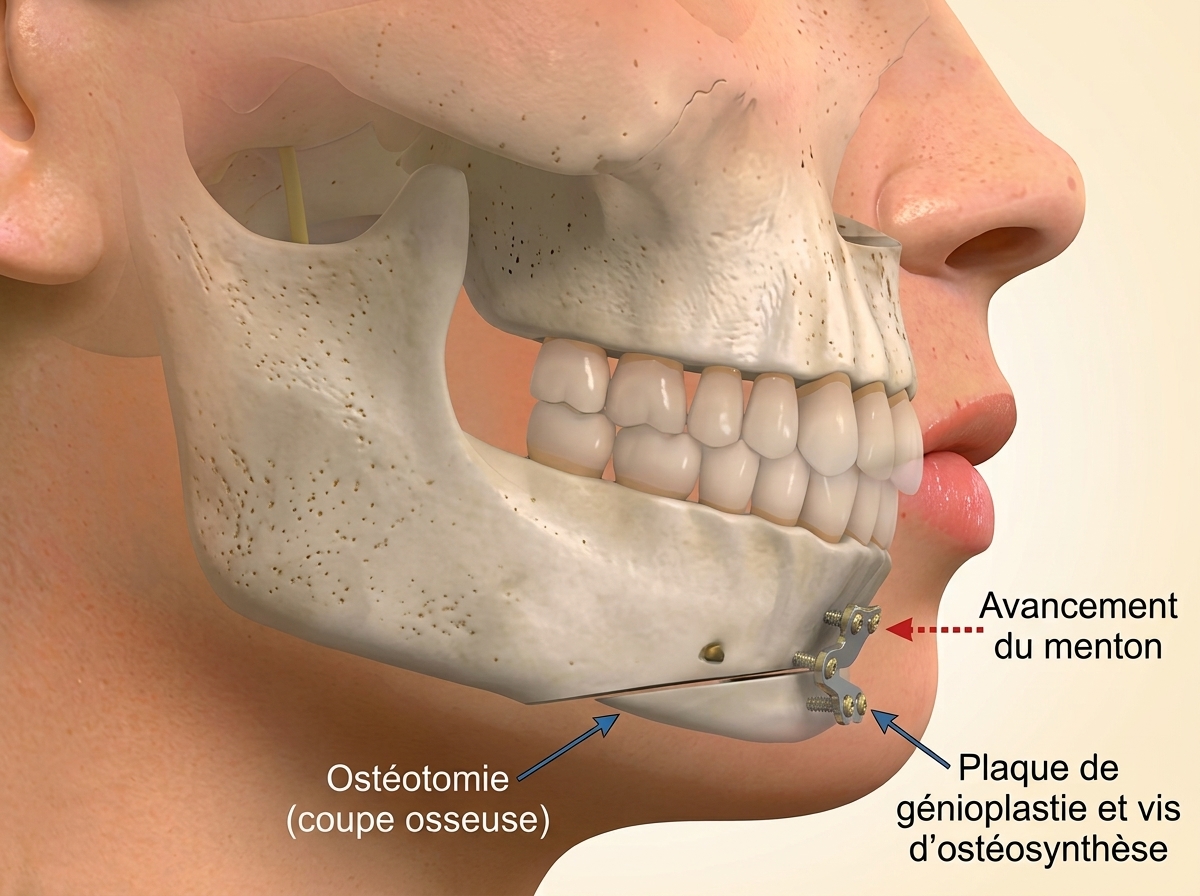
Who is it for? A markedly receding chin, a prominent chin, asymmetry or excess vertical height.
The technique: a hidden incision inside the mouth, with no visible scar; the chin bone segment is moved precisely in three dimensions, then fixed with titanium miniplates and screws.
Advantage: a permanent correction, a natural and lasting result, and improved tension of the soft tissues of the neck at the same time.
Genioplasty with an implant
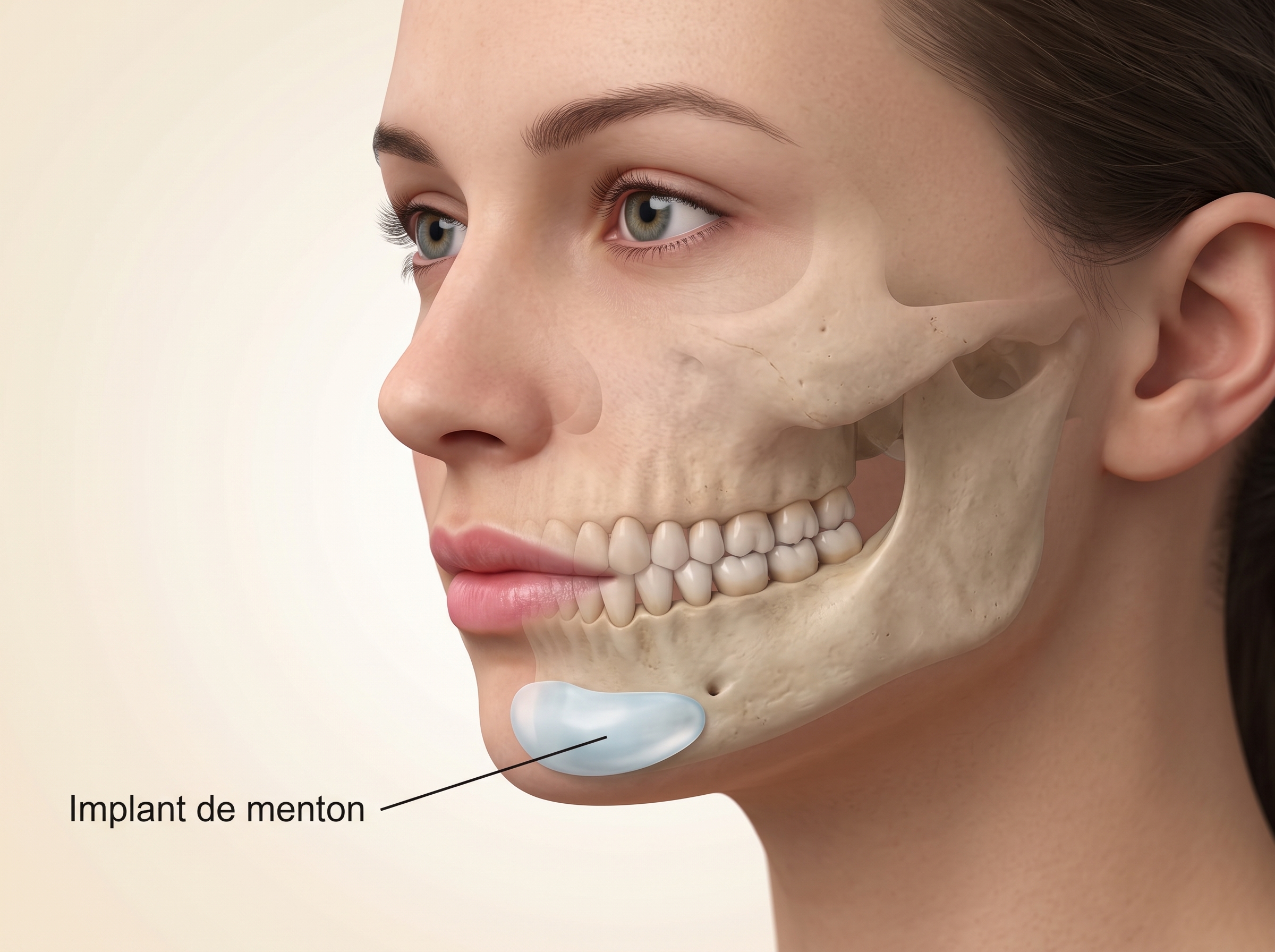
Who is it for? A moderately receding chin that needs more forward projection, with no vertical problem and no bite discrepancy.
The technique: placement of a custom biocompatible implant through the inside of the mouth.
Non-surgical profile correction
Who is it for? Mild deficiencies, irregularities or patients who want to try a temporary projection.
The technique: targeted injections of high-density hyaluronic acid against the bone to give the chin structure and redefine the face shape.
Frequently asked questions
Does a genioplasty leave visible scars? No. In the vast majority of cases the operation is performed inside the mouth (incision behind the lower lip): no scar is visible on the skin.
Is the operation painful? Usually only mildly. Recovery is mainly a mechanical discomfort from swelling and a pulling feeling in the lower lip; suitable painkillers are prescribed.
Will I lose sensation in my lip or chin? Temporary reduced sensation in the lower lip and chin is common, due to stretching of the branches of the mental nerve. Thanks to careful protection of the nerves, it recovers gradually in the weeks after surgery.
How does it differ from jaw surgery (orthognathic surgery)? A genioplasty only involves the chin bone and does not change the bite. If there is also a significant bite discrepancy, Dr Yousefpour will assess whether a lower jaw osteotomy should be added or preferred.
When can I return to sport and social life? About a week away from social activities is recommended. Quiet work can resume after 7 to 10 days, gentle exercise after 3 weeks; contact sports are suspended for 2 months.
Medical information: nature of the operation
A genioplasty corrects the shape of the chin through an osteotomy (cutting, moving and fixing the bone) or the placement of an implant, to bring the lower third of the face into harmony with the rest of the features. Every treatment plan aims for aesthetic balance while preserving the biomechanical and nerve integrity of the face.
Usual, expected recovery
Swelling and bruising of the chin and neck, settling within 2 to 3 weeks.
Temporarily limited mouth opening and difficulty speaking or chewing for the first few days.
Temporary numbness of the lower lip and chin area.
Careful oral hygiene is essential (mouthwash several times a day, adapted brushing).
Possible risks and complications
However carefully it is performed, every operation carries risks:
Haematoma or bleeding: may exceptionally require drainage.
Wound infection: prevented by sterile technique and antibiotics, but may require longer treatment or, with an implant, its temporary removal.
Residual sensory changes: reduced or altered sensation from the mental nerve; usually full recovery within a few months, although areas of partial permanent numbness remain possible, if rare.
Bone or hardware complications: delayed bone healing, intolerance to plates or screws requiring their later removal.
Aesthetic dissatisfaction: minor residual asymmetry, partial bone resorption or over- or under-correction, which may be revised later (after 6 to 12 months at the earliest).
Before and after surgery: recommendations
Smoking: stopping completely is essential for at least 4 weeks before and 4 weeks after surgery, to prevent delayed healing and tissue necrosis.
Medication: no medicines containing aspirin or anti-inflammatories in the 10 days before surgery without explicit approval.
Informed consent
You receive an information and informed consent document before the operation. By signing it, you confirm that Dr Afshin Yousefpour has explained the nature of the operation, the expected benefits, the alternatives (medical or surgical), the technical and aesthetic limits and the surgical and anaesthetic risks, that you have had enough time to reflect and that you have received clear answers to all your questions.
Frequently asked questions
What is the difference between a sliding genioplasty and a chin implant?
A sliding (bony) genioplasty moves the chin bone itself (forward, backward or repositioned) and suits a markedly receding chin, asymmetry or excess chin height. A chin implant adds forward projection for a moderately receding chin. The choice is made after clinical examination and 3D imaging.
Is there a visible scar?
No. Both the sliding genioplasty and the placement of an implant are done through an incision inside the mouth, with no visible scar on the face.
How long is the recovery?
Work and social activities can usually resume after 7 to 10 days. The result appears as the main swelling settles, after 3 to 6 weeks, and the bone has consolidated at 3 months.
Is there a non-surgical alternative?
For mild deficiencies, injections of high-density hyaluronic acid placed against the bone can give the chin temporary structure. They also make it possible to try out a projection before considering surgery.
Why entrust your chin to a maxillofacial surgeon?
The chin is a bony structure crossed by the mental nerve, which provides sensation to the lower lip. Trained in stomatology in Brussels (1997), then Consultant Specialist in oral and maxillofacial surgery in the United Kingdom (2006), Dr Yousefpour knows this bone and nerve anatomy in depth and assesses the chin together with the whole profile.
Before and after photos
Examples of genioplasty performed by Dr Yousefpour, including one case combining a mandibular angle implant with an advancement genioplasty, shown side by side before and after surgery. Every result is specific to the patient and their anatomy and is not a guarantee.
2 cases shown. Tap or click a case to enlarge.