Do I need jaw surgery? The warning signs to look out for
A misaligned jaw, a receding chin, front teeth that do not meet: the signs of a jaw imbalance and when orthodontics alone is no longer enough.
By Dr Afshin Yousefpour, oral and maxillofacial surgeon, Consultant Specialist (UK), FRCSEd · Published on 4 November 2026. See his background
Many patients have never heard the term "orthognathic surgery". They are looking for an explanation of what they notice: a jaw that seems out of line, a receding chin, lower teeth in front of the upper ones, or front teeth that do not meet. This article describes the signs of a jaw imbalance and explains when orthodontics alone is no longer enough.
Badly positioned teeth or misaligned jaws?
A bite problem can have two different causes:
- the position of the teeth: the jaws are well positioned, but the teeth are misaligned. Orthodontic treatment is usually enough;
- the position of the jawbones: the upper jaw, the lower jaw or both are too far forward, too far back, too long, too short or shifted to one side.
In the second case, orthodontics can compensate by tilting the teeth, but it does not move the bone. When the imbalance is significant, orthognathic surgery, also called jaw surgery, repositions the jaws themselves, together with the orthodontist.
The warning signs
A receding chin, a lower jaw set back
This is called mandibular retrognathia, or Class II. The chin seems to disappear, the upper teeth stick out well in front of the lower ones, and the profile looks "receding". This imbalance is sometimes accompanied by snoring or sleep apnoea, because a lower jaw that sits back reduces the space behind the tongue.
A lower jaw that juts forward
This is prognathism, or Class III: the lower teeth sit in front of the upper ones, and the chin looks prominent. Often the upper jaw is also set back, which makes the middle of the face look hollow.
Front teeth that do not meet
An anterior open bite: when you close your mouth, the back teeth touch but the front ones do not. It becomes hard to bite through food with the front teeth. An open bite is often linked to an upper jaw that is too long vertically.
A jaw shifted to one side
An asymmetry: the chin is off-centre, the midlines of the upper and lower teeth do not match, and one side of the face looks longer than the other. An asymmetry can also come with jaw joint problems.
A smile that shows a lot of gum
A gummy smile has several possible causes. When it is due to an upper jaw that sits too high, only repositioning that jaw corrects it permanently.
Other associated signs
- difficulty chewing, biting or closing the lips without effort;
- mouth breathing, snoring, sleep apnoea;
- pain or clicking in the jaw joint;
- abnormal wear on some teeth;
- a narrow palate with a crossbite, covered in our article Narrow palate in adults: why and how to widen it?.
None of these signs is enough on its own to decide. They do, however, justify an assessment.
How do you know whether surgery is needed?
Only an examination can tell. At Face Clinic in Waterloo, the assessment takes one consultation:
- a clinical examination of the face, the smile, the bite and the jaw joints;
- a large-field CBCT, a low-dose 3D scan, which shows the position of the jaws, the teeth and the nerve;
- a digital impression of the teeth with the intraoral scanner, with no paste;
- 3D photographs of the face.
This data makes it possible to measure the imbalance and to tell apart what is due to the bone and what is due to the position of the teeth. The decision is made with your orthodontist: orthodontics alone, or orthodontics combined with surgery.
If surgery is recommended: what to expect
Treatment usually takes place in three stages:
- Orthodontic preparation lasting 6 to 18 months, which aligns the teeth on each jaw.
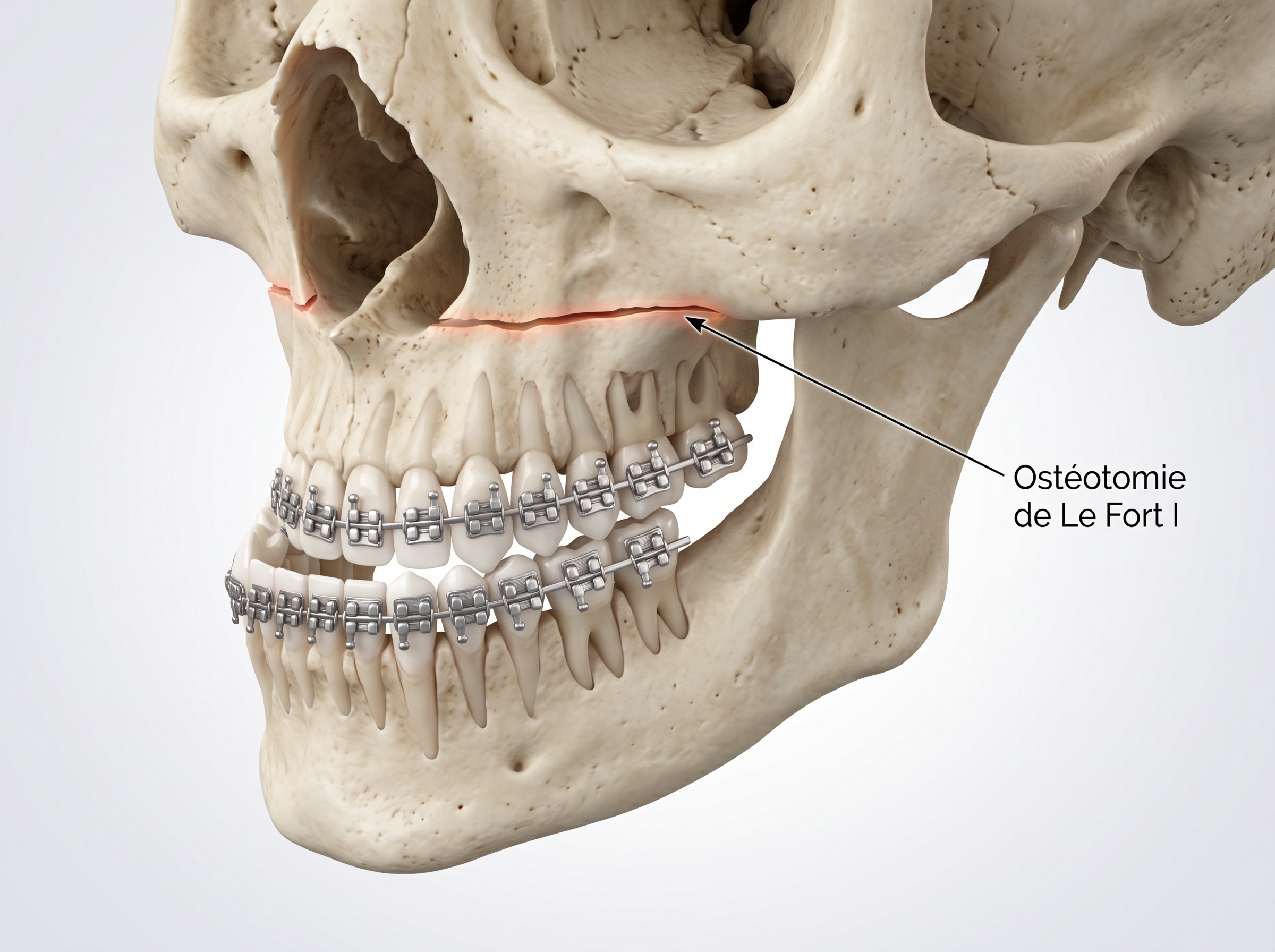
- The operation, prepared with virtual 3D planning in the Dolphin Imaging software. Depending on the imbalance, it involves the upper jaw (Le Fort I osteotomy), the lower jaw (sagittal split osteotomy), both (bimaxillary surgery), and sometimes the chin (genioplasty). It is done from inside the mouth, under general anaesthetic, with 1 to 2 nights in hospital.
- Orthodontic finishing for a few months.
Recovery after the operation is described in detail in the article Recovery after orthognathic surgery, week by week.
At what age should you seek advice?
Jaw surgery is usually done at the end of growth, from around 18. A first opinion can, however, be useful earlier, as soon as your orthodontist suspects a bone imbalance: it helps steer the orthodontic treatment in the right direction. There is no upper age limit; general health matters more than age.
In summary
- A receding chin, a jaw that juts forward, front teeth that do not meet or a jaw shifted to one side can reveal an imbalance of the jawbones.
- When the bones are out of line, orthodontics alone can only compensate; orthognathic surgery repositions the jaws.
- An assessment with 3D imaging shows what is needed in your case, together with your orthodontist.
To find out more, see the Orthognathic surgery page. Dr Yousefpour sees patients at Face Clinic in Waterloo and at Delta Hospital in Brussels: book an appointment.
This article is general information. Only a consultation can determine the right treatment for your situation.