Recovery after orthognathic surgery, week by week
Pain, swelling, diet, sleep, work and sport: what to expect week by week after jaw surgery.
By Dr Afshin Yousefpour, oral and maxillofacial surgeon, Consultant Specialist (UK), FRCSEd · Published on 4 November 2026. See his background
"Will it hurt?", "How long will I be swollen?", "When can I go back to work?": these are the most common questions before jaw surgery. Here is how recovery usually goes, week by week. Every patient recovers at their own pace, and the written instructions given to you after the operation remain the reference.
In hospital: the first 24 to 48 hours
The operation is done under general anaesthetic and takes 2 to 5 hours, depending on whether one or both jaws are involved. It is followed by 1 to 2 nights in hospital.
When you wake up, the face is already swollen and the lips are often numb. Pain is controlled with painkillers given at regular times. Light elastic bands guide the bite, without locking the jaws. You leave hospital once you are drinking and eating enough, with your written instructions and your medicines.
Week 1: swelling takes centre stage
This is the most uncomfortable week.
- Swelling increases over the first few days and peaks around the third day, then gradually goes down. Bruising may appear on the cheeks or neck.
- Cold helps a lot: a cooling mask or ice, in 20-minute sessions, for the first 48 to 72 hours.
- Sleep with your head raised, on two pillows, to limit swelling.
- Pain is usually moderate and well controlled if the prescribed painkillers and anti-inflammatories are taken at regular times, without waiting for it to build up.
- The lips tend to dry out: moisturise them often with petroleum jelly.
- After upper jaw surgery, the nose is often blocked in the first week. Use only a saline spray.
Do not force your mouth open during this first week. Take short, regular walks: lying down all the time is not advised.
Weeks 2 and 3: gradually back to activities
The swelling goes down markedly, even if a more discreet part remains for several weeks. Energy comes back.
- Normal activities usually resume after 2 to 3 weeks. Office work is often possible by then; physical work takes longer.
- Around day ten, gentle exercises begin to regain mouth opening: slow movements, without forcing, to reach an opening of one to two finger widths.
- Post-operative check-ups make sure healing, the bite and the elastics are on track, and tell you when to move from a liquid to a soft diet.
Diet: 2 weeks liquid, then 2 weeks soft
The bone takes 6 to 8 weeks to heal. During this time, the plates holding the jaws in their new position must not be put under strain.
- For the first 2 weeks, the diet is liquid.
- For the next 2 weeks, it is soft: tender foods that mash easily, with nothing hard or sticky.
- After that, you gradually return to a normal diet.
- Split it into 5 to 6 small meals a day and enrich them (butter, cream, protein supplements) to avoid losing too much weight.
- Drink 2 to 3 litres a day, preferably cold or lukewarm in the first few days.
- After upper jaw surgery, for 4 weeks: do not blow your nose, do not sneeze with your mouth closed and do not use a straw.
Post-operative check-ups confirm at each stage that you can move on to the next.
After 6 to 8 weeks: the bone has healed
The bone has healed. Sport is resumed gradually: no contact sport and no intense cardiovascular effort for 6 to 8 weeks. The orthodontist then carries out the finishing adjustments over a few months.
Feeling in the lip and chin
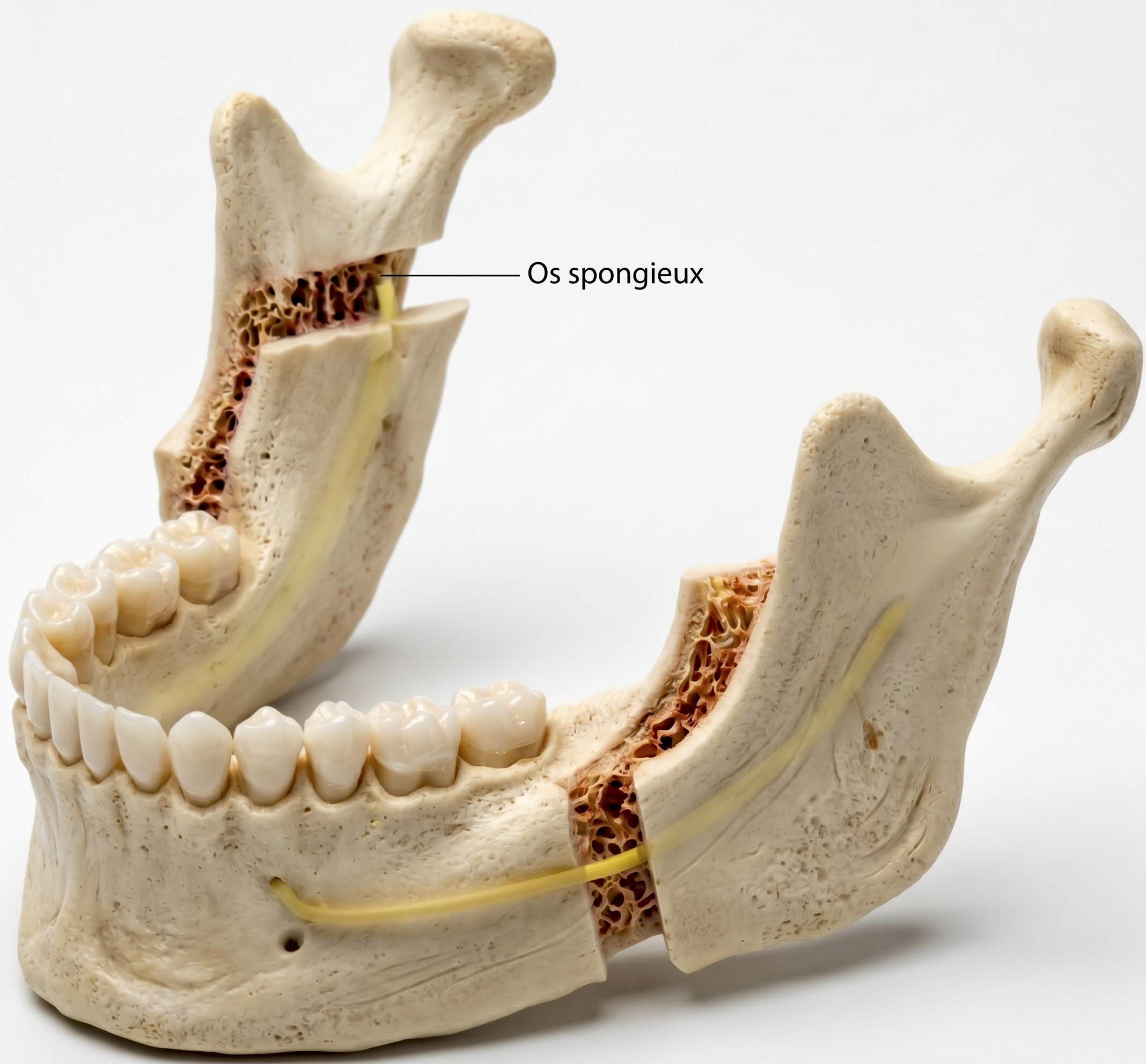
After a lower jaw osteotomy, loss of feeling in the lower lip and chin is common at first, because the inferior alveolar nerve runs through the bone at that point. Fortunately, it is usually temporary and recovers gradually over several months. It can, however, sometimes be permanent, most often as partial numbness. In that case, the brain adapts over time: the sensation becomes less and less bothersome, and many patients end up no longer noticing it in daily life. After upper jaw surgery, the upper lip and the sides of the nose can be temporarily numb.
The path of the nerve is mapped in 3D on the CBCT before the operation, and cutting the bone with piezosurgery (ultrasound) helps limit this risk.
Oral hygiene
- From the next day, brush your teeth and brace after every meal with an ultra-soft brush, without touching the gum incisions.
- After 48 hours, start mouthwashes (chlorhexidine or salt water), without vigorous gargling.
- Apply orthodontic wax to any wires that rub the inside of the cheeks.
- Stopping smoking is essential: it slows bone healing and increases the risk of infection.
When to contact Dr Yousefpour
Let the practice know promptly about pain that gets worse instead of better, swelling that increases after the fourth day, fever, unusual discharge or bleeding that will not stop. If a sign is severe or sudden, do not wait for a reply: go to the emergency department.
In summary
- Week 1: swelling peaks around the third day; cold, head raised, painkillers at regular times.
- Weeks 2 and 3: gradual return to normal activities, start of mouth-opening exercises.
- Diet: liquid for 2 weeks, then soft for 2 weeks, before returning to a normal diet.
- 6 to 8 weeks: the bone heals and sport is gradually resumed.
To find out whether jaw surgery is right for you, read Do I need jaw surgery? The warning signs to look out for, or see the Orthognathic surgery page. The full instructions are available in the post-operative instructions.
This article is general information. The instructions given to you after your operation and Dr Yousefpour's advice take precedence over this guidance.