

Socket preservation
Preserving the bone volume of the socket after a tooth extraction.
Duration
20 to 45 minutes
Anaesthesia
Local (supplemented for comfort if needed)
Hospital stay
Day case
Recovery
Usually simple, moderate recovery; 3 to 6 months of bone maturation before implant placement
Socket preservation (socket grafting) is an essential preventive procedure performed immediately after a tooth is extracted. Its main aim is to preserve the volume and density of the jaw bone and the architecture of the gum, creating ideal conditions for a future dental implant or for the appearance of the smile.
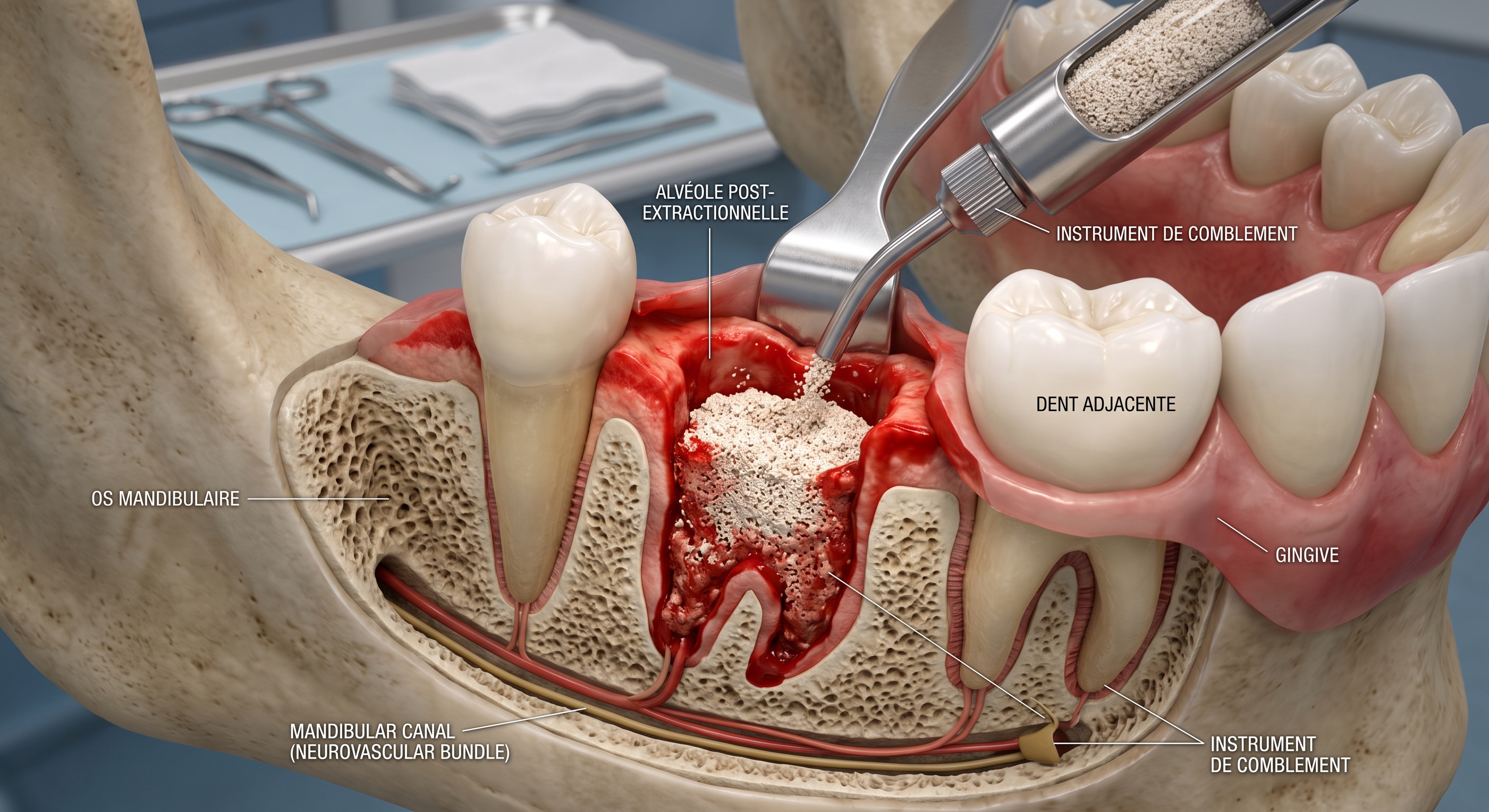
The protocol, step by step.
- Step 1
Assessment and 3D planning
3D CBCT imaging analyses the bone anatomy and the thickness of the socket walls; digital simulation anticipates the future implant position to guide the procedure from the extraction onwards.
- Step 2
Atraumatic extraction
The tooth is removed with great care, using ultrasonic piezosurgery instruments if needed, to preserve the delicate bony walls of the socket.
- Step 3
Filling and protecting the socket
The cleaned socket is filled with the chosen biomaterial, protected by a resorbable or non-resorbable membrane and stabilised with atraumatic sutures.
- Step 4
Follow-up and bone maturation
Healing is monitored at check-ups; after bone maturation, usually 3 to 6 months, the implant is placed in regenerated, solid and stable bone.
Why is socket preservation so important?
When a tooth is extracted, the bone that supported it (the socket) naturally resorbs. In the months after extraction, significant bone volume is lost (in width and height), which can compromise later implant placement or create an aesthetic problem (particularly in the visible area of the smile).
Limiting natural bone loss by acting as a regeneration matrix.
Maintaining the gum architecture for a harmonious and natural prosthetic and aesthetic result.
Reducing the need for later, more complex and invasive bone grafts.
Optimising the initial and long-term stability of future dental implants.
Our surgical expertise
As a specialist oral and maxillofacial surgeon, our practice rests on in-depth command of pre-implant and reconstructive surgery. Each case undergoes careful clinical and radiological analysis to choose the most suitable grafting technique and biomaterial.
Atraumatic surgery: the extraction is performed with great care (including piezosurgery or minimally invasive techniques) to preserve the delicate bony walls of the socket.
Careful choice of biomaterials: only high-quality, osteoconductive and biocompatible bone substitutes, for predictable, high-quality bone regeneration.
Soft-tissue management: tight closure and atraumatic sutures to protect the graft, stimulate gum healing and avoid premature exposure of the material.
Advanced diagnostic and digital precision
Integrating the most advanced digital and radiological technology into our practice ensures maximum safety and predictability.
3D CBCT (cone beam CT) imaging: pre-operative three-dimensional analysis of the bone anatomy, nearby key structures and the thickness of the socket walls.
Computer-assisted 3D planning: digital simulation and anticipation of the future implant position to guide the procedure from the extraction onwards.
Ultra-precise surgery (piezosurgery): ultrasonic instruments for selective bone cutting that respects soft tissues and blood vessels.
The procedure and recovery
The procedure: performed under local anaesthesia (supplemented for comfort if needed), straight after the extraction. The cleaned socket is filled with the biomaterial, often protected by a resorbable or non-resorbable membrane and stabilised with sutures.
Recovery: usually simple and moderate. Suitable treatment is prescribed (painkillers, mouthwash and, if needed, antibiotics or anti-inflammatories), along with precise post-operative instructions for optimal healing.
Healing period: a bone maturation period (usually 3 to 6 months, depending on the case) is observed before the dental implant is placed in regenerated, solid and stable bone.
Specialist consultation
Do you need a tooth extracted, or would you like to plan high-precision implant treatment? Book a specialist consultation for a personalised assessment of your situation.