
Not enough bone for a dental implant: what are the options?
Told you do not have enough bone for an implant? Why bone disappears, and the solutions: bone graft, sinus lift, socket preservation, short implants.
By Dr Afshin Yousefpour, oral and maxillofacial surgeon, Consultant Specialist (UK), FRCSEd · Published on 5 November 2026. See his background
"You do not have enough bone for an implant." Many patients hear this and think an implant is no longer possible. In the vast majority of cases it still is: the bone can be rebuilt, or the implant adapted to the bone available. This article explains why bone is missing and what solutions exist.
Why does bone disappear?
The bone around a tooth exists only to support it. When the tooth is lost, the bone is no longer stimulated and shrinks. The loss is fastest in the first few months after the extraction, then continues more slowly.
Other causes are often added:
- gum disease (periodontitis), which destroys the bone around the teeth;
- an infection or a cyst at the root of a tooth;
- a difficult extraction that damaged the bone wall;
- a denture worn for years, pressing on the ridge;
- in the upper jaw, the sinus expanding downwards after the molars are lost.
How do we know whether there is enough bone?
A panoramic X-ray is not enough, because it does not show the width of the bone. The CBCT (3D scan) precisely measures the height, width and density of the bone, and the distance to the nerve of the lower jaw and to the sinus. The solution is chosen on that basis.
The solutions, depending on the situation
| Situation | Usual solution |
|---|---|
| Tooth about to be extracted | Socket preservation on the day of the extraction |
| Bone slightly too thin | Small graft with a membrane, often at the same time as the implant |
| Very thin or very low ridge | Block bone graft, then implant after 4 to 6 months |
| Not enough height under the sinus | Sinus lift, with or without an implant at the same time |
| Limited height but good-quality bone | Short implant, sometimes without a graft |
| Severely shrunken upper jaw | Zygomatic implants, anchored in the cheekbone |
Socket preservation: preventing rather than rebuilding
At the time of the extraction, the tooth socket is filled with a bone substitute and protected. This greatly limits bone loss and makes it easier to place the implant 4 to 6 months later. See the Socket preservation page.
Bone grafting
When the ridge is too thin or too low, it is rebuilt:
- with particles of bone or substitute, protected by a membrane, for small defects;
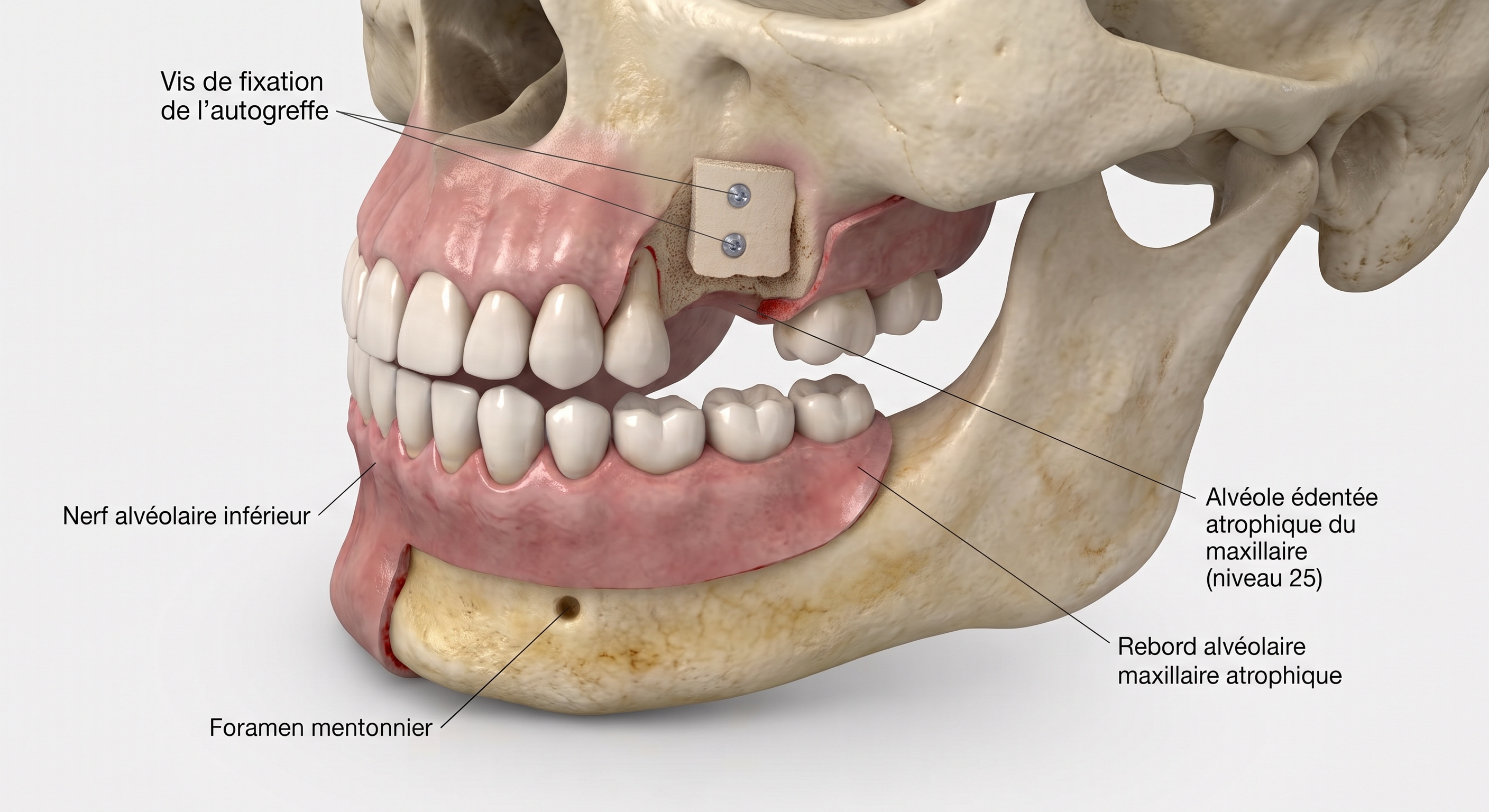
- with a block of bone taken from you, usually from the back of the lower jaw, and fixed with small screws, for larger defects.
The procedure is done under local anaesthetic, as a day case. Swelling peaks between 48 and 72 hours, then subsides over about ten days. The implant is placed after 4 to 6 months of maturation. See the Bone grafting page.
Sinus lift
At the back of the upper jaw, height is often lacking because the sinus has dropped. The sinus lining is then lifted and the space is filled. We describe this procedure in detail in the article Sinus lift: procedure, recovery and timeline.
Short implants
Short implants (about 6 mm or less) are an alternative when the bone height is limited but its quality is good. They sometimes avoid a graft or a sinus lift, with a shorter treatment. They are not suitable for every situation, especially when the future crown would be very tall compared with the implant. The choice between a short implant and reconstruction is made on the scan, weighing the advantages of each option.
Zygomatic implants
For a severely shrunken upper jaw, longer implants can be anchored in the cheekbone (zygomatic bone). With the extra-sinus technique, they do not pass through the sinus cavity. They make it possible to fix a full arch without major bone reconstruction, when that is not desirable or not possible.
Why a maxillofacial surgeon?
Bone reconstruction involves delicate areas: the nerve of the lower lip, the sinus, the sites where bone is taken. Dr Yousefpour, a maxillofacial surgeon for more than 25 years, performs all of these techniques, from small grafts to zygomatic implants. He can therefore offer the least invasive solution suited to your bone, rather than the only technique available.
Frequently asked questions
When is it "too late" for an implant? Rarely. Even after years without a tooth, the bone can usually be rebuilt, or bypassed with short or zygomatic implants. However, the longer you wait, the larger the reconstruction needs to be.
Does a bone graft always take? It succeeds in the vast majority of cases. Smoking, poor hygiene and exposure of the graft in the mouth are the main causes of failure. Follow-up in the first few weeks is therefore important.
Can the graft and the implant be done at the same time? Yes, when the remaining bone can hold the implant stable. Otherwise, the graft is done first and the implant is placed after maturation.
In summary
- Bone shrinks after a tooth is lost, especially in the first few months.
- A lack of bone almost never prevents an implant from being placed.
- The solution depends on the 3D scan: socket preservation, graft, sinus lift, short implant or zygomatic implant.
- Socket preservation at the time of extraction often avoids a graft later.
For how the placement works, read Having a dental implant placed: steps, pain and timeline. All the information is on the Dental implants page.
This article is general information. Only a consultation can determine the right treatment for your situation.