
Having a dental implant placed: steps, pain and timeline
How a dental implant is placed: 3D assessment, the procedure, pain, recovery, the wait for the final tooth, and same-day implants.
By Dr Afshin Yousefpour, oral and maxillofacial surgeon, Consultant Specialist (UK), FRCSEd · Published on 5 November 2026. See his background
Many patients put off having an implant because they fear the pain or do not know how long it takes. Here is, step by step, how the treatment works, what you feel, and when a tooth can be fitted on the same day.
1. The assessment: everything is decided before the procedure
The assessment determines whether the implant can be placed straight away, and where. At Face Clinic in Waterloo, it takes one consultation:
- a large-field CBCT (low-dose 3D scan) measures the height and width of the bone, and locates the nerve of the lower jaw and the sinus of the upper jaw;
- a digital impression with the intraoral scanner, with no impression paste;
- photographs of the smile.
The images are merged to plan in 3D the ideal position of the implant, based on the future tooth. Depending on the case, this plan is followed during the procedure with a surgical guide or with X-Guide dynamic navigation, which shows the position of the drill in real time.
Above all, the scan shows whether there is enough bone in height and width:
- there is enough bone: the implant is simply placed;
- a little bone is missing: it is built up with a bone substitute while the implant is placed;
- a lot of bone is missing: a bone graft is done first, and the implant is placed a few months later.
Immediate or delayed implant?
When a tooth needs to be removed, there are two options:
- the immediate implant: it is placed on the day of the extraction, when appropriate, that is when the bone around the tooth is intact and free of infection;
- the delayed implant: the socket (the hole left by the tooth) is first left to heal for 3 to 4 months, or 4 to 6 months if the socket was filled at the time of the extraction. The height and width of the bone are then measured on CBCT before the implant is placed.
2. The procedure
| In practice | |
|---|---|
| Duration | 45 minutes to 2 hours depending on the number of implants |
| Anaesthesia | Local, sedation possible for anxious patients |
| Hospital stay | No, you go home the same day |
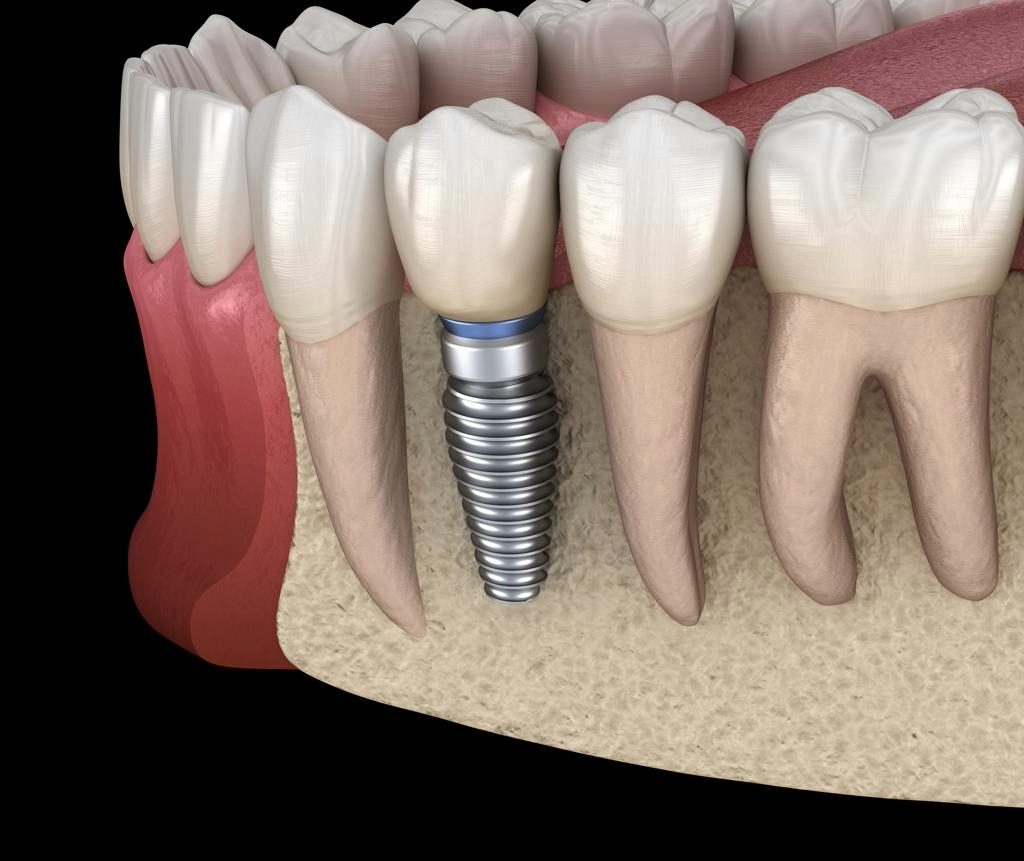
Once the area is numb, the gum is opened over a few millimetres, the bone is prepared and the implant is screwed in. With guided surgery, the opening in the gum is sometimes minimal. You feel no pain during the procedure, only vibration and pressure.
Does it hurt?
Most patients are surprised: having a simple implant placed is often described as less unpleasant than an extraction. After the procedure:
- moderate discomfort and swelling are common for 2 to 4 days;
- bruising may appear, especially after a graft;
- ordinary painkillers are usually enough.
Recovery is more marked when a bone graft or a sinus lift is done at the same time.
The first few days
- Cold on the cheek for the first few hours, to limit swelling.
- Soft food, without chewing on the implant side for a few days.
- No smoking: it clearly increases the risk of the implant failing.
- Hygiene: mouthwashes as prescribed, gentle brushing around the area.
- Work: most patients go back the next day or the day after.
You are given the full instructions in writing. You can also find them in the patient resources.
3. One stage or two stages?
Depending on how stable the implant is and on the quality of the bone, Dr Yousefpour chooses one of these two approaches:
- One stage: a small healing screw is fitted onto the implant as soon as it is placed. It sticks out slightly above the gum, which heals around it. No second procedure is needed.
- Two stages:
- the implant is buried under the gum, protected from pressure while it fuses with the bone;
- after 3 to 4 months, it is uncovered in a small procedure under local anaesthetic, and a healing screw is fitted.
The healing screw is a temporary part that lets the gum heal around the implant. It should not be confused with the abutment, the permanent part to which the crown is fixed, which is only fitted at the end of the treatment. The fees for each stage are set out in the article Cost of a dental implant in Belgium.
4. Osseointegration: 3 to 4 months
The bone gradually fuses with the surface of the implant: this is osseointegration. After each implant is placed, you need to wait 3 to 4 months for this osseointegration.
You are not left without a tooth during this time when the area is visible: a temporary tooth is possible.
5. The final crown, checked before it is fitted
If you were referred by your dentist, you go back to them for this stage and for all the restorative work. It is only done at the practice for patients who do not have a dentist or who were not referred by a dentist:
- Impression: about two weeks after the healing screw is fitted, an impression is taken and sent to the laboratory.
- Try-in: the laboratory sends back a trial version of the future tooth. Its width, thickness and height are checked, and the tooth is only approved once Dr Yousefpour and you are happy with it.
- Fitting the abutment and the crown: the final crown arrives one to two weeks later. The healing screw is removed, the abutment is screwed onto the implant and the crown is fixed on top. Thanks to the earlier checks, it usually goes on without difficulty.
An implant and a tooth in one day: for whom?
This is called immediate loading: the temporary tooth is fixed onto the implant on the day it is placed. It is possible when:
- the implant is very stable as soon as it is placed, which depends on the quality and quantity of bone;
- there is no significant infection at the site;
- the temporary tooth can be adjusted so that it does not take excessive chewing forces.
Studies comparing immediate loading with conventional loading show no clear difference in failure rates in the first year, provided the implant is well stabilised. The choice is therefore made case by case, after the 3D assessment. The tooth fitted on the same day remains a temporary tooth: the final crown is made after osseointegration.
The timeline at a glance
| Stage | Usual duration |
|---|---|
| Assessment and 3D planning | 1 consultation |
| Socket healing (delayed implant) | 3 to 4 months, 4 to 6 months after socket filling |
| Bone graft, if needed | 4 to 6 months of maturation before the implant |
| Implant placement | 45 minutes to 2 hours |
| Osseointegration | 3 to 4 months |
| Uncovering and healing screw (two-stage placement) | Small procedure under local anaesthetic, 3 to 4 months after placement |
| Impression | About 2 weeks later |
| Try-in, then abutment and final crown | 1 to 2 weeks between the two |
Frequently asked questions
How long does an implant last? A well-integrated implant, looked after with good oral hygiene and regular check-ups with your dentist, can last many years, often a lifetime. Smoking, poorly controlled diabetes and inflammation of the gum around the implant (peri-implantitis) are its main enemies.
Can an implant be rejected? It is not rejection as with an organ transplant. In non-smokers and non-diabetics, more than 95% of implants fuse with the bone. When an implant does not take, it is removed and, in most cases, placed again after healing. At the practice, this new placement is free of charge for patients who do not smoke and do not have diabetes, apart from any bone substitute (see Cost of a dental implant in Belgium).
Can the implant be placed on the day of the extraction? Yes, when appropriate: this is the immediate implant. Otherwise, the socket heals for 3 to 4 months. If socket preservation is done at the time of the extraction to preserve the bone, you need to wait 4 to 6 months, as after a bone graft or a sinus lift.
What if I do not have enough bone? It is common, and it is not a contraindication. Read Not enough bone for a dental implant: what are the options?
In summary
- The 3D assessment decides everything: the position of the implant, the need for a graft, the possibility of a same-day tooth.
- The procedure is done under local anaesthetic, with no hospital stay.
- The discomfort usually lasts a few days and is controlled with ordinary painkillers.
- Allow about 4 to 5 months between placing the implant and the final crown, with a temporary tooth if needed.
- The crown is tried in before it is fitted, so that you can approve its shape together.
For cost and reimbursement, read Cost of a dental implant in Belgium: what matters and what is reimbursed. All the information on implant treatment at the Waterloo practice is on the Dental implants page.
This article is general information. Only a consultation can determine the right treatment for your situation.