
Narrow palate in adults: why and how to widen it?
Narrow palate, crossbite, mouth breathing: why a palatal expander alone is no longer enough in adults and what solutions exist.
By Dr Afshin Yousefpour, oral and maxillofacial surgeon, Consultant Specialist (UK), FRCSEd · Published on 1 November 2026. See his background
A narrow palate is a common problem, often discovered in adulthood, when an orthodontist notices that the upper teeth no longer properly overlap the lower ones. In children, it is easily corrected with a palatal expander. In adults, the situation is different: the bone of the palate has fused and no longer separates under the pressure of an appliance alone.
This article explains how to recognise a narrow palate, why it is worth correcting and what solutions exist after growth has finished.
How do you recognise a narrow palate?
A narrow palate, or transverse maxillary deficiency, means the upper jaw is too narrow compared with the lower jaw. The most common signs are:
- a crossbite: on one or both sides, the upper teeth sit inside the lower ones instead of overlapping them;
- crowding in the upper jaw: the teeth lack space and overlap;
- a deep, high-arched palate, visible when the mouth is open;
- dark corridors at the sides of the smile, making the smile look narrow;
- mouth breathing, a nose that is often blocked, sometimes snoring.
Only a clinical examination, completed by 3D imaging, can measure the deficiency precisely and tell apart what is due to the bone and what is due to the position of the teeth.
Why correct a narrow palate in adulthood?
Widening the palate is not only about aligning the teeth. Correction can:
- restore a good bite between the upper and lower teeth, and spread the chewing forces;
- create the space needed for orthodontics, without having to extract healthy teeth;
- widen the floor of the nasal cavity, because the palate also forms its base. In some patients, breathing through the nose becomes easier;
- widen the smile and reduce the dark corridors;
- prepare for jaw surgery (orthognathic surgery) when other imbalances need correcting.
Why a palatal expander alone is no longer enough in adults
The palate is made of two halves of bone joined in the middle by a joint, the midpalatal suture. In children, this suture is still flexible: an expander fixed to the teeth is enough to open it.
With age, the suture gradually fuses. In adults, the pressure of a conventional expander can no longer open it. Instead, it mainly tips the teeth outwards, which gives an unstable result and can weaken the gum and bone around the roots.
To truly widen the bone of the palate in an adult, the appliance must either be anchored directly in the bone, or the suture must be helped to open with a surgical procedure.
The two solutions in adults
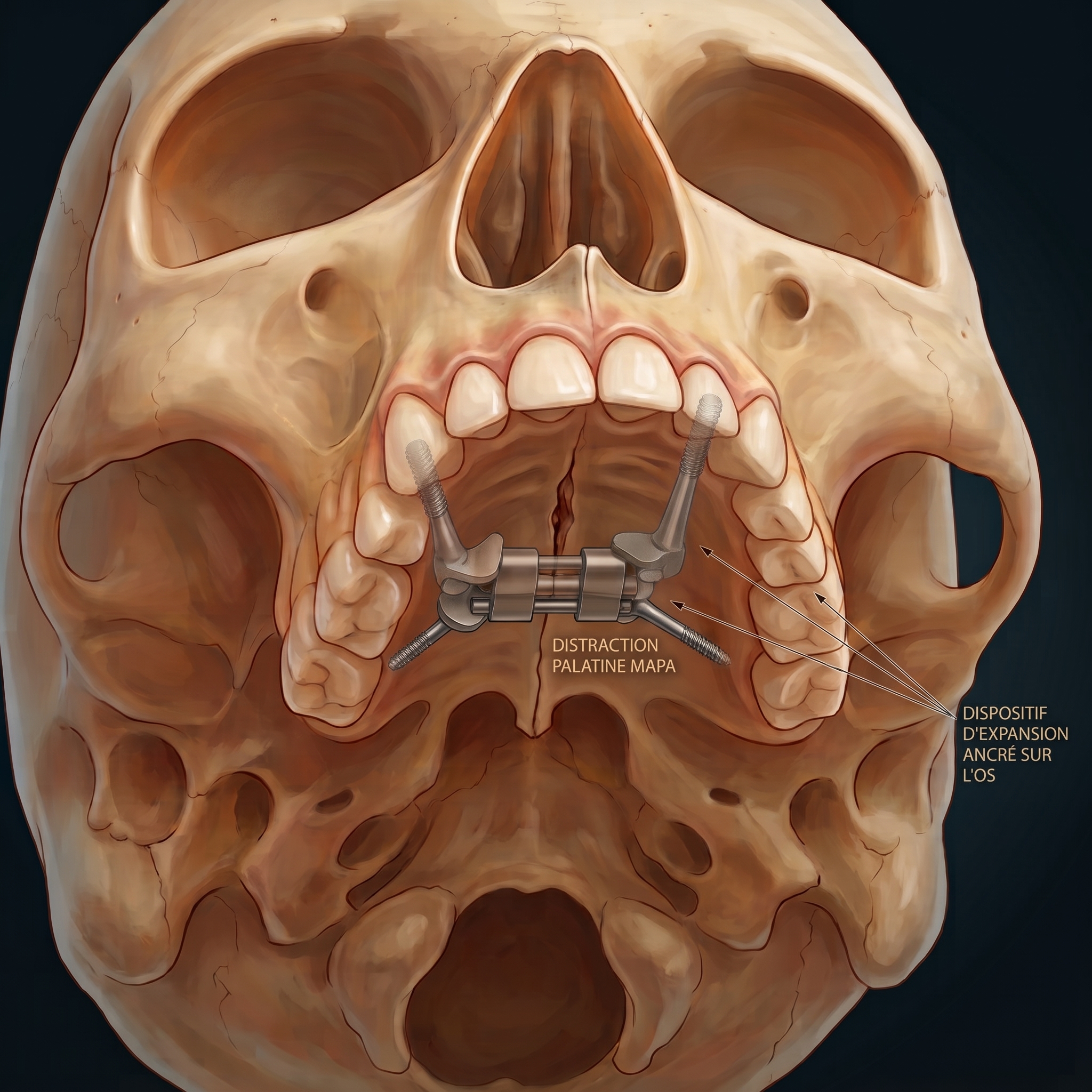
Miniscrew-assisted expansion (MARPE)
The expander is anchored in the bone of the palate with small temporary anchoring screws. The expansion force goes directly through the bone, without pushing the teeth. This technique needs no incision. It works well in teenagers at the end of growth and in young adults, but its success becomes less predictable when the suture is firmly fused.
Surgical palatal distraction (SARPE)
Under anaesthetic, Dr Yousefpour makes targeted bone cuts (osteotomies) that free the upper jaw. The expander is then activated gradually over a few days, and bone forms again in the space created: this is the principle of distraction osteogenesis. This technique widens the palate reliably, whatever the age.
The choice between the two depends on age, how mature the suture is, how much widening is needed and the condition of the gum. We compare the two techniques in detail in the article MARPE or surgical palatal distraction: which technique to choose?.
The assessment at the practice
At Face Clinic in Waterloo, the assessment is done on site in a single consultation:
- a large-field CBCT (low-dose 3D scan) to measure the width of the jaws, the thickness of the palate bone and how far the suture has closed;
- a digital impression with the intraoral scanner, with no paste;
- 3D photographs of the face and smile.
The treatment plan is drawn up with your orthodontist, who then aligns the teeth.
In summary
- A narrow palate often shows up as a crossbite, crowding or mouth breathing.
- In adults, a conventional expander tips the teeth instead of widening the bone.
- Two solutions widen the bone: MARPE, with no incision, and surgical palatal distraction, more predictable in adults.
- A 3D assessment makes it possible to choose the right technique.
To find out how palatal distraction works in practice, read Surgical palatal distraction: procedure, pain and duration, or see the Palatal distraction page.
This article is general information. Only a consultation can determine the right treatment for your situation.