
Dental implant: surgical guide or X-Guide navigation?
3D-printed surgical guide or X-Guide dynamic navigation: accuracy according to the research, benefits, limits and indications of each technique for implant placement.
By Dr Afshin Yousefpour, oral and maxillofacial surgeon, Consultant Specialist (UK), FRCSEd · Published on 19 November 2026. See his background
To place an implant exactly where it was planned on the 3D scan, two technologies are available today: the surgical guide, a custom 3D-printed template that directs the drill, and dynamic navigation, which tracks the drill in real time on a screen, like a satnav. At the Waterloo practice both are used, including the X-Guide system. Which is more accurate? Which suits your case? Here is what the research shows.
Two ways to carry out the same plan
Both techniques start with the same step: a 3D scan (CBCT) and a digital impression allow the ideal implant position to be planned on screen, taking account of the bone, nerves, sinus and future tooth. The difference lies in how that plan is transferred to the mouth on the day of surgery. For the principle of 3D planning, read Computer-guided implant surgery.
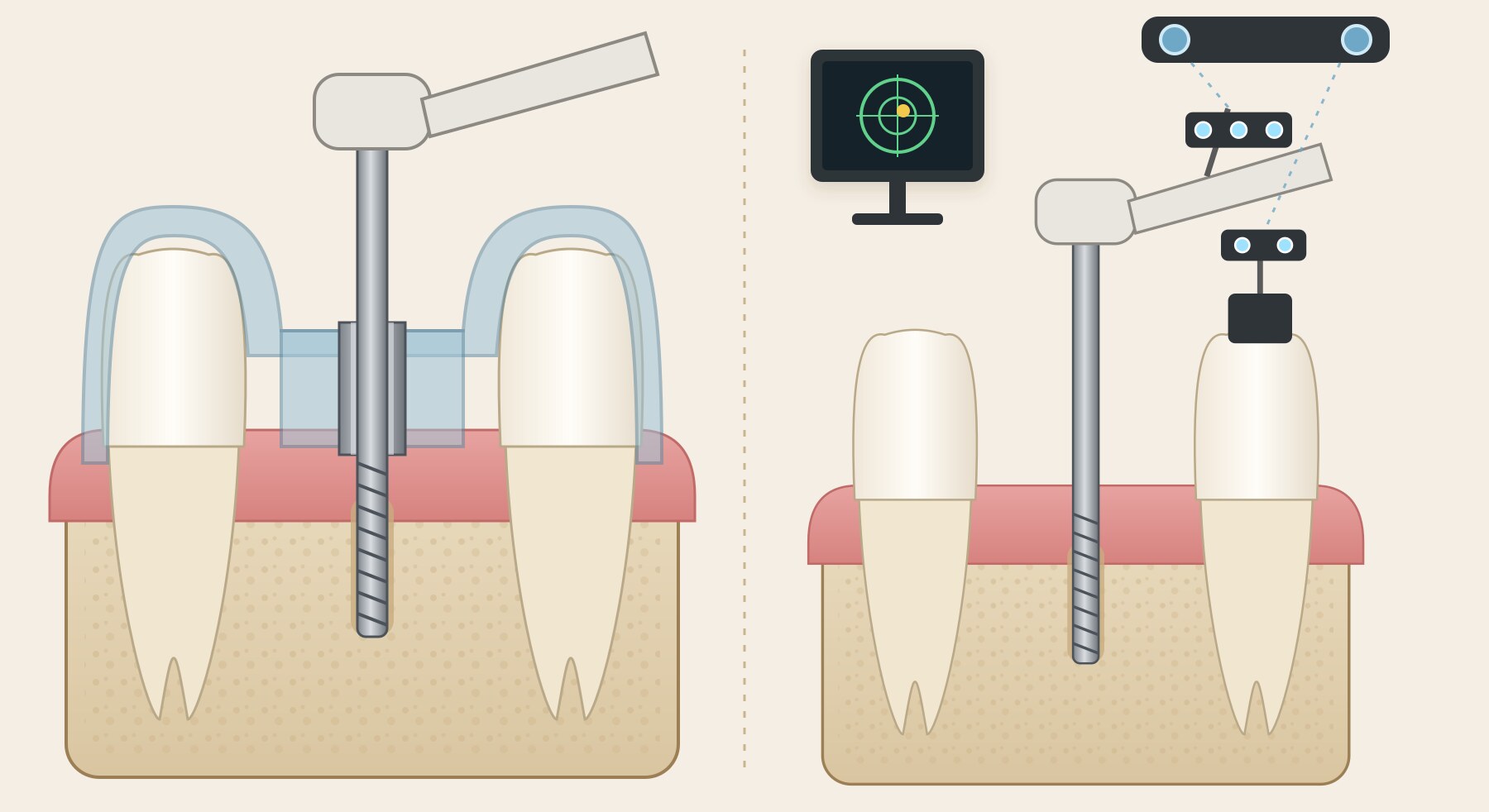
The surgical guide (“static” guided surgery)
A resin template is designed from the plan and 3D printed. It fits over the teeth, or over the gum and bone in a patient with no teeth. Metal sleeves built into the guide set the position, angle and sometimes the depth of drilling. The surgeon cannot stray from the planned path.
Accuracy depends above all on the fit and stability of the guide in the mouth: a guide that tilts by a few tenths of a millimetre carries that error all the way to the implant tip. The combined height of guide and drill also needs enough mouth opening, which can limit access to the back teeth.
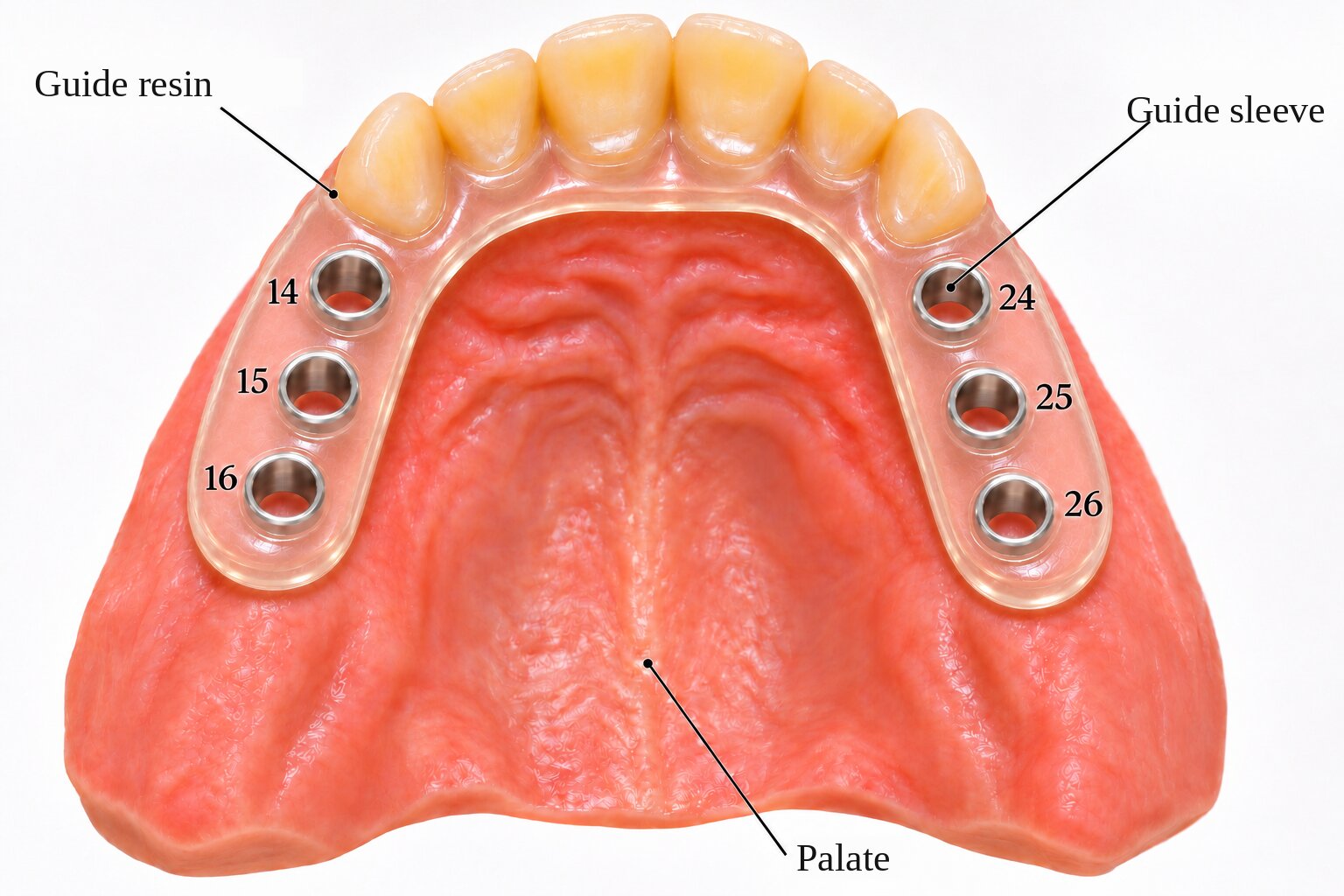
Surgical guide for the upper jaw: each metal sleeve directs the drilling for one implant, here at positions 14, 15, 16 and 24, 25, 26.
X-Guide dynamic navigation
A small marker is attached temporarily to the teeth, and another to the handpiece. A camera tracks these markers continuously, and a screen shows the drill position against the plan in real time: entry point, angle and depth. The surgeon lines up the movement with the target on screen, with no template in the mouth, and compares the actual path with the planned one throughout.
Before drilling, the system is calibrated and its accuracy is checked by touching known reference points, such as a tooth. Its reliability depends on the quality of the initial scan, on this registration, and on repeated checks during surgery.
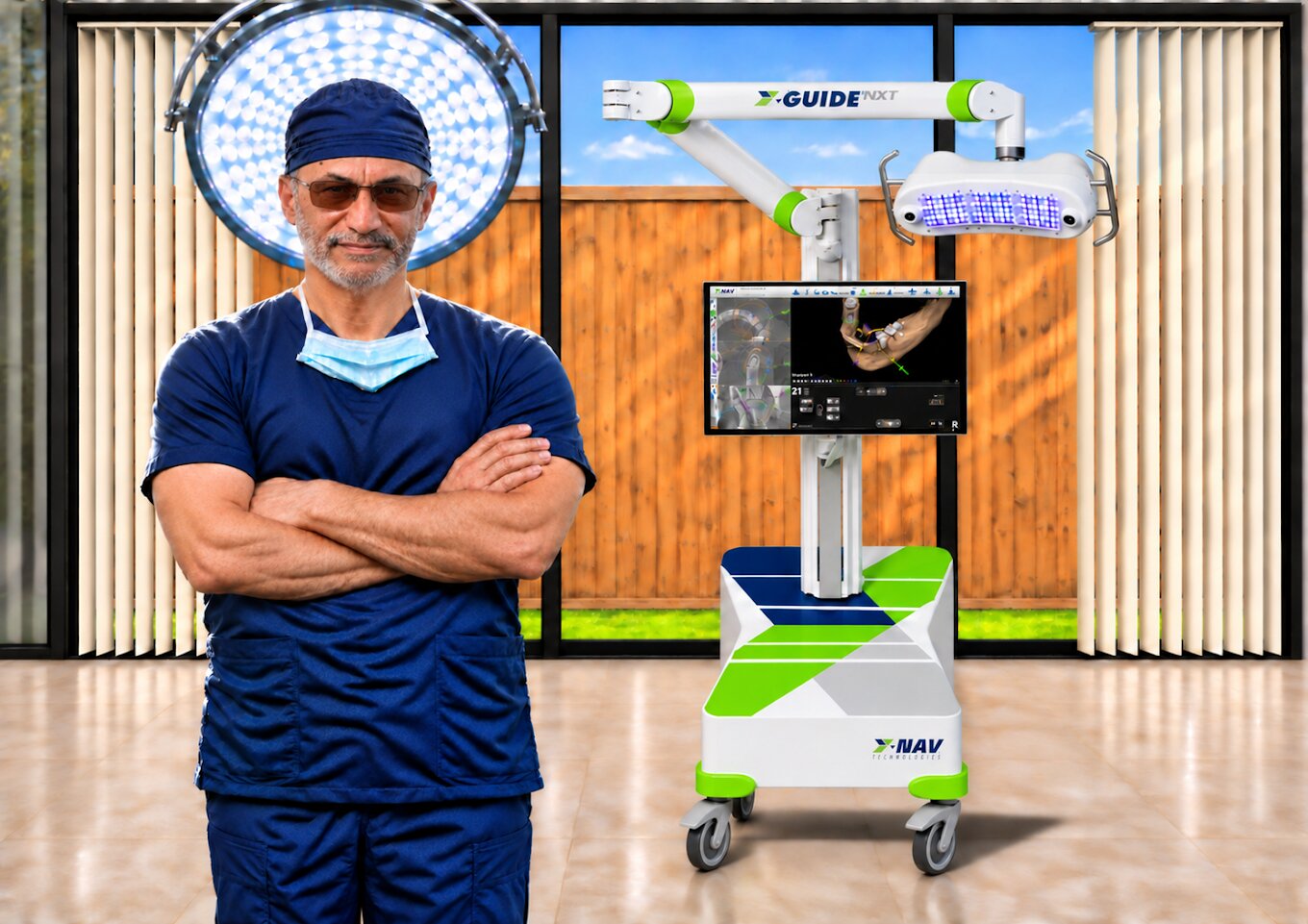
Dr Yousefpour with the X-Guide NXT dynamic navigation system used at the practice: the camera tracks the markers and the screen shows the drill against the 3D plan.
What the scientific literature says
Accuracy is measured by superimposing the post-operative scan on the original plan, comparing the deviation at the implant entry, at its tip (the apex), and in angle.
The surgical guide has been studied in thousands of implants. According to the landmark review by Tahmaseb et al. (2018), adopted in the ITI consensus, the mean deviation is about 1.2 mm at entry, 1.4 to 1.5 mm at the apex and 3.5° in angle. Accuracy is better when the guide rests on teeth than in fully edentulous patients.
Dynamic navigation gives results of the same order. In a randomised trial of 60 patients comparing both techniques for a single tooth (Kaewsiri et al., 2019), accuracy was comparable. Several meta-analyses reach the same conclusion: navigation is as accurate as a guide, and clearly more accurate than freehand placement. A recent meta-analysis (Li et al., 2024) even found a slight advantage for navigation in apex position and depth, but the difference is around 0.1 to 0.2 mm.
Two points are consistent across all these studies:
- no technique achieves zero error: deviations of more than 1 mm remain possible, and a safety margin of about 2 mm from the nerve and other sensitive structures is recommended;
- navigation has a learning curve: accuracy improves with the surgeon’s experience, as Block et al. showed for the X-Guide system as early as 2017.
In practice, neither technology is “better” in absolute terms. The right choice depends on the situation.
The strengths of each technique
| Surgical guide | X-Guide navigation | |
|---|---|---|
| Accuracy | Very good, widely documented | Comparable to the guide |
| Preparation | Guide design and printing | No guide to make |
| Change during surgery | Not possible without abandoning the guide | Possible, the plan adapts |
| Limited mouth opening | A problem: guide plus long drills | No template, more room |
| Back of the mouth | Access sometimes difficult | Well suited |
| Bone cooling | Irrigation through the sleeves | Direct irrigation |
| Visual control | The guide partly hides the site | Clear site, live view on screen |
When is the surgical guide preferred?
- for several implants in an arch where remaining teeth give stable support;
- when the position of the future prosthesis is already fully defined, for example for an implant bridge prepared with the dentist;
- in many straightforward cases, where it gives high accuracy with a well-established protocol.
When is navigation preferred?
- with limited mouth opening, or for molars, where a guide and long drills lack room;
- in narrow sites or close to an obstacle (inferior alveolar nerve, sinus, neighbouring roots), where seeing the path in real time helps;
- when the plan may need adapting during surgery, for example after an extraction, or if the bone turns out different from what the scan suggested;
- to combine the implant with a sinus lift or a bone graft in the same session.
Technology does not replace the surgeon
Guide or navigation, the tool only carries out a plan. The quality of that plan, reading the scan, and handling fragile bone or the unexpected remain the surgeon’s job. That is why the choice between the two is made case by case, at consultation, on your CBCT. Dr Yousefpour, a maxillofacial surgeon with 25 years of surgical experience, uses one or the other depending on what gives your situation the most safety.
One decision among others
Choosing between a guide and navigation is only one part of the treatment plan. Other decisions matter just as much for the result: is a bone graft or sinus lift needed before or during placement? What temporary tooth during healing? When can the final crown be put into function? These choices depend on your clinical situation and are discussed with you, and with your dentist for the restorative part.
What to ask at your consultation
- Show me the planned position of the implant and the future tooth on the 3D scan.
- Why this guidance method for me: what about my anatomy or the surgical access makes it suitable?
- What safety margin is planned from the nerve, sinus or neighbouring roots?
- Do I need a graft, and what temporary solution will I have while it heals?
These questions link the tool to the treatment planned. Dr Yousefpour takes the time to answer them, with the 3D image in front of you.
Frequently asked questions
Is navigation more painful? No. Both techniques are carried out under local anaesthetic and often allow surgery without opening the gum widely. The marker on the teeth is removed at the end.
Are extra appointments needed? The assessment (CBCT, digital impression, photos) is the same. A guide needs time for design and printing; navigation does not.
Is a fixed tooth on the same day possible with these techniques? Yes, in some cases: when there is enough bone and the implant is very stable from the moment it is placed, a fixed temporary tooth can be screwed in on the same day.
In summary
- The surgical guide and X-Guide navigation both carry out a plan made in 3D.
- Studies show comparable accuracy, clearly better than freehand.
- The guide is very reliable for well-defined cases with stable support on teeth.
- Navigation is an asset at the back of the mouth, with limited opening or when the plan must adapt.
- The choice is made at consultation, on your scan.
All the information about implants at the Waterloo practice is on the Dental implants page. To discuss your situation, see how to book an appointment.
References
- Tahmaseb A. et al. The accuracy of static computer-aided implant surgery: a systematic review and meta-analysis. Clinical Oral Implants Research, 2018;29(S16):416-435.
- Kaewsiri D. et al. The accuracy of static vs. dynamic computer-assisted implant surgery in single tooth space: a randomized controlled trial. Clinical Oral Implants Research, 2019. doi:10.1111/clr.13435
- Block M.S. et al. Implant placement accuracy using dynamic navigation. International Journal of Oral & Maxillofacial Implants, 2017;32(1):92-99.
- Jorba-García A. et al. Accuracy assessment of dynamic computer-aided implant placement: a systematic review and meta-analysis. Clinical Oral Investigations, 2021. doi:10.1007/s00784-021-03833-8
- Li K. et al. Dynamic navigation vs. static navigation in implant placement: a meta-analysis. Journal of Dentistry, 2024. doi:10.1016/j.jdent.2024.105395
This article is general information. Only a consultation can determine the right treatment for your situation.