Receding chin: genioplasty or jaw surgery?
Receding chin: how to tell whether only the chin needs correcting or the lower jaw must move forward, and what genioplasty, chin implants and fillers can do.
By Dr Afshin Yousefpour, oral and maxillofacial surgeon, Consultant Specialist (UK), FRCSEd · Published on 6 November 2026. See his background
A receding chin is one of the most common reasons for a consultation. Some patients simply want a more balanced profile. Others also have difficulty chewing, snore or feel tired when they wake up. The right solution depends on a simple question: does the problem come from the chin alone, or from the whole lower jaw?
Two very different situations
Only the chin sits back (retrogenia). The teeth fit together correctly, the jaw is well positioned, but the tip of the chin lacks projection. Only the chin needs correcting.
The whole lower jaw sits back (retrognathia). The upper teeth stick out well in front of the lower ones (this is called Class II), the chin looks receding and the neck poorly defined. Correcting only the chin would improve the profile, but would leave the bite out of line and the space for breathing reduced.
How can you tell the difference?
A few signs point the way:
- Do your upper front teeth stick out several millimetres in front of the lower ones?
- Have you worn a brace, sometimes with extractions, without your profile changing?
- Do you snore, or are you tired when you wake up?
- Do your lips close only with effort, with the chin tensing?
If you answer yes to several of these questions, the whole jaw is probably involved. The assessment at the practice, with CBCT, a digital impression and 3D photographs, makes it possible to decide objectively.
The solutions
| Situation | Solution |
|---|---|
| Mild retrogenia | Hyaluronic acid injections or a chin implant |
| Marked retrogenia, asymmetry or chin too high | Bony genioplasty |
| Retrognathia with a misaligned bite | Lower jaw advancement (orthognathic surgery), sometimes combined with a genioplasty |
Injections
For a mild deficit, high-density hyaluronic acid injected against the bone gives the chin structure. The effect is temporary. Injections also make it possible to test a projection before choosing a permanent solution.
Chin implant
An implant, inserted through an incision inside the mouth, adds horizontal projection. It suits moderate retrogenia.
Bony genioplasty
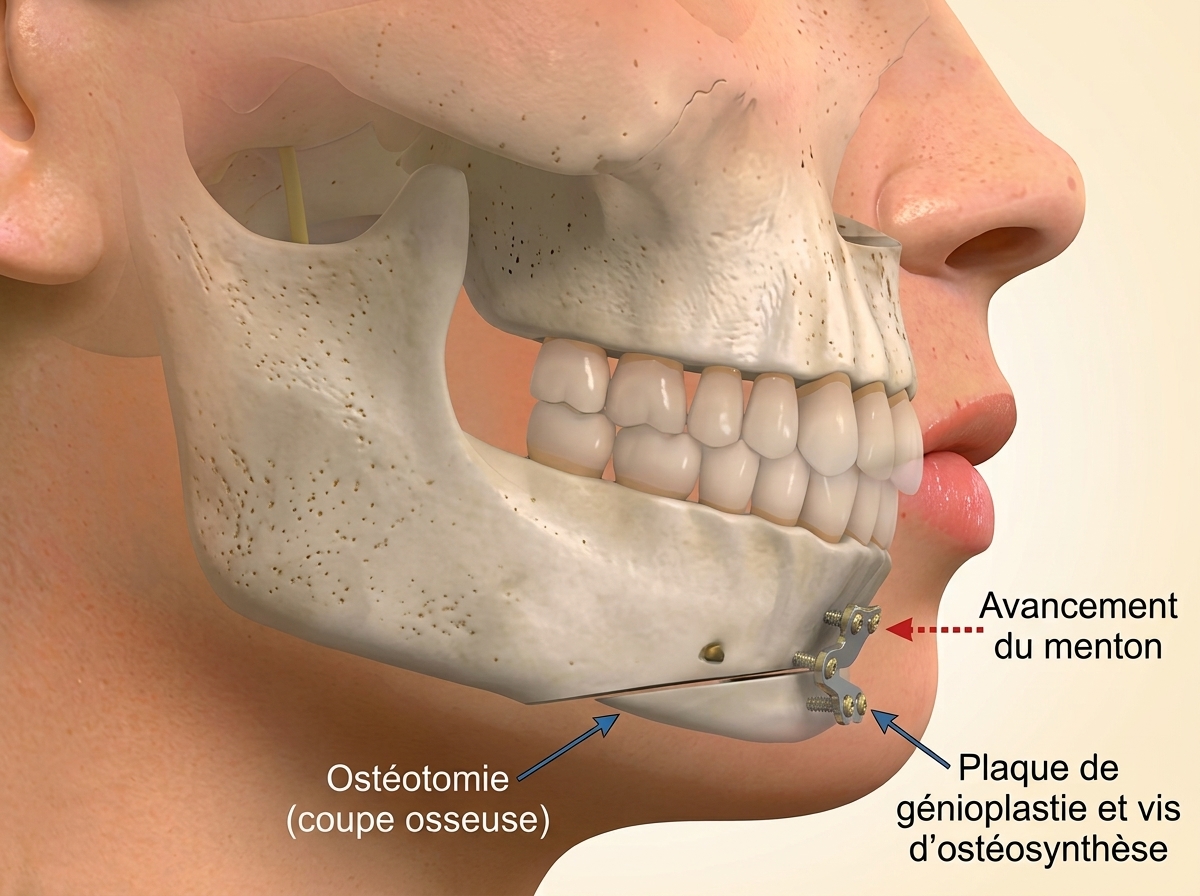
Dr Yousefpour cuts the tip of the chin and moves it: forwards, backwards, up, down or to the side. The bone is fixed with a small titanium plate. The operation takes 1 to 2 hours, is usually a day case, and leaves no visible scar. You can return to your activities after 7 to 10 days, and the bone has healed at 3 months. See the Genioplasty page.
Lower jaw advancement
When the whole jaw sits back, it is brought forward with a sagittal split osteotomy on both sides. The chin comes forward with it, the teeth fit together correctly, and the space behind the tongue widens. This operation is part of orthognathic surgery: it is prepared with orthodontics and planned in 3D. See Orthognathic surgery: the stages of treatment.
A genioplasty can be added in the same operation to refine the shape of the chin.
Receding chin and breathing
A lower jaw that sits back pushes the tongue backwards and can contribute to snoring and sleep apnoea. In that case, a genioplasty or an implant on its own does not bring the same benefit as moving the jaws forward. Read Sleep apnoea: when can jaw surgery help?
Why a maxillofacial surgeon?
The chin is crossed by the mental nerve, which gives the lower lip its feeling. The lower jaw contains the inferior alveolar nerve. A maxillofacial surgeon can offer every option, from injections to jaw surgery, and choose the one that suits your anatomy rather than the only technique they perform.
In summary
- A receding chin can come from the chin alone or from the whole lower jaw.
- If the teeth fit together well, a genioplasty, an implant or injections are often enough.
- If the teeth are out of line, lower jaw advancement corrects the profile, the bite and often the breathing at the same time.
- The 3D assessment makes it possible to choose objectively.
This article is general information. Only a consultation can determine the right treatment for your situation.