Primary rhinoplasty: why the first nose operation matters most
Primary rhinoplasty: why the diagnosis and treatment plan made at the first consultation help avoid a more difficult revision rhinoplasty.
By Dr Afshin Yousefpour, oral and maxillofacial surgeon, Consultant Specialist (UK), FRCSEd · Published on 10 November 2026. See his background
A first rhinoplasty is the best opportunity your nose will ever have. The bones and cartilages are intact, the anatomical layers are clear, and there is no internal scarring. That is why primary rhinoplasty, the first operation on a nose that has never been operated on, is Dr Yousefpour’s preferred procedure. A revision, by contrast, is done on ground that has already been altered. So everything is decided before the first operation: in the diagnosis and treatment plan made at the first consultation.
Why the first operation matters so much
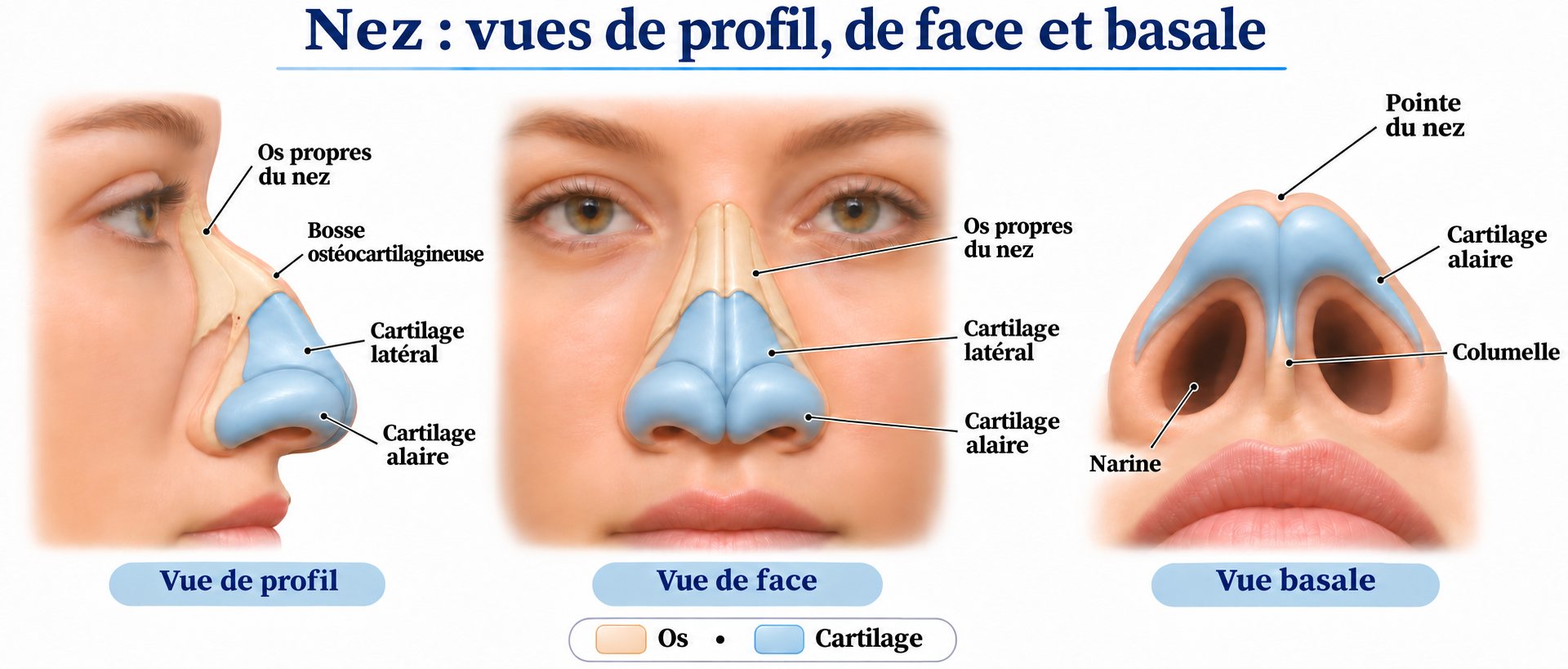
The nose is not a rigid block. It is a linked structure of bone, cartilage, ligaments and lining, under constant tension. Changing one part affects the others, both the look of the nose and breathing.
In a first operation, the surgeon works on intact structures: they can reshape, strengthen and preserve in the best conditions. Surgery is more predictable.
What makes a revision difficult
Secondary rhinoplasty is for patients unhappy with the aesthetic result, or who breathe poorly after one or more operations. It is more difficult for specific reasons:
- fibrous scar tissue, which has replaced the natural anatomical layers;
- a lack of supporting cartilage, when too much cartilage was removed at the first operation;
- typical deformities of an over-reduced nose: "inverted V", saddle nose, pinched tip, retracted nostrils;
- the need for grafts taken from what remains of the septum, from the ear or from the ribs, to rebuild the framework.
A revision takes longer (often 2.5 to 4 hours, compared with 1.5 to 2.5 hours for a primary operation), and you need to wait at least 12 months, ideally 18 months with thick skin, before considering it. Its costs are also entirely the patient’s responsibility.
What often leads to a revision
Many revisions start at the first consultation, not in the operating theatre:
- breathing overlooked: a deviated septum, enlarged turbinates or weak nasal valves that were not examined or treated;
- over-reduction: removing too much bone or cartilage looks good in the short term, but over the years the nose collapses or the tip pinches;
- the nose treated in isolation: without considering the forehead, jaws and chin, a "successful" nose can still look out of balance in the face;
- skin misjudged: thick skin does not shrink like thin skin, and hides the detail of the tip;
- unclear expectations: a vague or unrealistic goal that patient and surgeon have not clearly agreed together.
What the first consultation should include
With Dr Yousefpour, the treatment plan is based on three complementary assessments.
| Assessment | What is examined |
|---|---|
| Functional | Examination inside the nose: septum, turbinates, nasal valves |
| Aesthetic | Photographic analysis of the profile and front view, nose–forehead and nose–chin proportions |
| The whole face | How the nose relates to the jaws and chin, skin quality and thickness |
These assessments lead to a bespoke plan, discussed with you: what will be changed, what will be preserved, and the limits your anatomy sets. This is when a realistic goal is agreed.
As a maxillofacial surgeon with expertise in aesthetic and reconstructive facial plastic surgery, Dr Yousefpour approaches the nose as part of the architecture of the face. Sometimes the analysis shows that a receding chin makes the nose look too big: the solution may then also involve the chin.
A structural and preservation approach
The aim is not only to reduce, but to build a nose that stays stable over time:
- reducing a hump millimetre by millimetre, without weakening the cartilages;
- refining or repositioning the tip with sutures and, if needed, a strut of the patient’s own cartilage;
- straightening the septum and treating the turbinates in the same operation when breathing requires it (septorhinoplasty);
- choosing the open or closed approach according to your anatomy, with scars hidden inside the nostrils or under the columella.
The priority remains breathing, for life.
After the operation
| In practice | |
|---|---|
| Duration | 1.5 to 2.5 hours |
| Anaesthesia | General |
| Hospital stay | Day case or one night |
| Splint | 7 to 10 days |
| Time away from social life | 8 to 10 days |
| Swelling | About 80% gone within 2 to 3 months |
| Final result | Between 9 and 18 months |
So the result is judged over time. A touch-up is never considered before internal healing is complete, that is 12 to 18 months.
Questions to ask before surgery
- Will you examine the inside of my nose and my breathing?
- What do you plan to change, and what will you preserve?
- Is my nose in balance with my chin and jaws?
- What limits do my skin and anatomy set?
- Can you show me before-and-after results of patients?
- Who provides follow-up over the next 12 to 18 months?
Cost and reimbursement
When examination confirms a deviated septum that obstructs breathing, the functional part (septoplasty) may be partly reimbursed by INAMI and your health insurance fund or hospital insurance. The purely aesthetic part is your responsibility and is subject to 21% VAT. The initial operation does not include any revision.
Frequently asked questions
Can a perfect result be guaranteed? No. Nasal surgery depends on healing, tissue contraction and cartilage memory. An accurate diagnosis and a well-built plan greatly reduce the risk of needing another operation, but no surgeon can guarantee a perfect result.
Can breathing and the look of the nose be improved at the same time? Yes, and it is often better that way. Septorhinoplasty treats the septum and turbinates in the same operation as reshaping the nose.
Can a non-surgical "liquid rhinoplasty" replace surgery? It can soften a hump or correct a small asymmetry without surgery. But it does not reduce a large nose and does not improve breathing. It also carries rare but serious vascular risks, which are explained at the consultation.
My nose was broken years ago. Is it still a primary rhinoplasty? Yes, if it has never been operated on. It is then a primary post-traumatic rhinoplasty, which has its own specific features: we cover it in a separate article.
In summary
- Primary rhinoplasty is done on intact structures: it is your nose’s best chance.
- A revision is longer, less predictable, often needs grafts and must wait 12 to 18 months.
- Many revisions stem from an incomplete diagnosis: breathing overlooked, over-reduction, the nose treated in isolation.
- The first consultation should assess function, aesthetics and the whole face, and lead to a realistic plan.
- The final result is judged between 9 and 18 months.
All the information and before-and-after photos are on the Rhinoplasty page.
This article is general information. Only a consultation can determine the right treatment for your situation.