
Surgical palatal distraction: procedure, pain and duration
Palatal distraction in adults, step by step: the operation, activating the expander, pain, diet, returning to work and total duration.
By Dr Afshin Yousefpour, oral and maxillofacial surgeon, Consultant Specialist (UK), FRCSEd · Published on 1 November 2026. See his background
Surgical palatal distraction, also called SARPE (Surgically Assisted Rapid Palatal Expansion), makes it possible to widen a palate that is too narrow in an adult. Patients often ask the same questions: does it hurt, how long does it take, and what are the first few weeks like? Here is how it works, step by step.
1. Before the operation
Treatment starts with an assessment at the practice: 3D CBCT, digital impression and photographs. Your orthodontist and Dr Yousefpour draw up the treatment plan together.
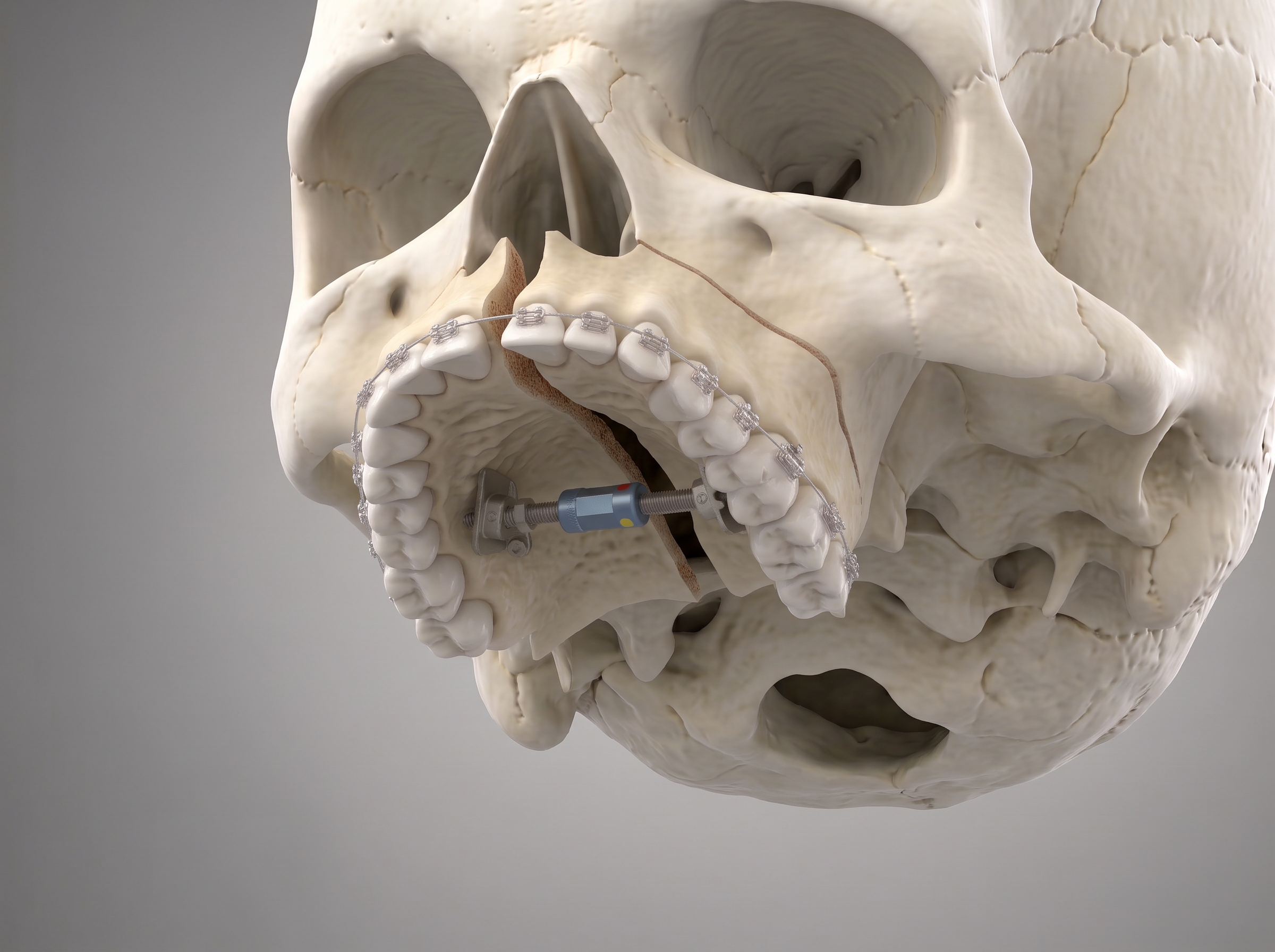
The expander is then prepared. It is a small fixed appliance placed in the palate, with a central screw that allows it to be widened gradually. Depending on the technique chosen, it is fixed to the teeth, to miniscrews placed in the bone, or to both.
2. The operation
The operation takes 1 to 2 hours and is done under general anaesthetic, usually as a day case.
From inside the mouth, Dr Yousefpour makes precise bone cuts that free the upper jaw where it resists widening. There is no visible scar on the face. At the end of the operation, the expander is activated slightly to check that the two halves of the palate separate symmetrically.
3. The rest phase (a few days)
For the first 5 to 7 days, the expander is not activated. This waiting period allows bone healing to start: it is this healing that will fill the space created.
This is when swelling is most marked. It decreases clearly after the third day.
4. Activating the expander (10 to 15 days)
You then activate the expander screw yourself with a small key, following a precise rhythm: usually a quarter of a millimetre once or twice a day. The duration depends on how much widening is needed. It is most often 10 to 15 days.
During this phase:
- a gap appears between the two upper front teeth (a diastema). This is normal, and actually the sign that the palate is widening. Your orthodontist will close it afterwards;
- you feel a sensation of tension in the palate, sometimes at the bridge of the nose or under the eyes, for a few minutes after each activation;
- you are seen regularly for check-ups to make sure the widening is progressing symmetrically.
Does it hurt?
Most patients describe discomfort rather than pain: a feeling of pressure, tension in the palate and nose, swelling in the first few days. It is usually well controlled with the ordinary painkillers prescribed when you leave.
The tension felt with each activation is brief and fades as the days go by.
Eating, speaking, working
- Diet: liquid for 2 weeks, then soft for 2 weeks, before returning to a normal diet. Hard and sticky foods, which can damage the appliance, are avoided.
- Speech: the expander can slightly change your pronunciation for a few days, until your tongue gets used to it.
- Hygiene: careful rinsing and brushing after every meal. A water flosser helps to clean under the appliance.
- Back to work: usually after one week for office work, depending on swelling and your activity.
5. Consolidation (3 to 6 months)
Once the desired width is reached, the screw is locked and the expander stays in place for 3 to 6 months. During this time, bone forms again and becomes solid in the space created. By then the appliance is hardly bothersome.
6. Orthodontics
Orthodontics can start during or after consolidation. It closes the gap between the front teeth and aligns the teeth in the new, wider arch. How long it takes depends on each case. It is often 12 to 24 months in total.
The timeline at a glance
| Stage | Usual duration |
|---|---|
| Operation | 1 to 2 hours, day case |
| Rest period before activation | 5 to 7 days |
| Activating the expander | 10 to 15 days on average |
| Consolidation, expander in place | 3 to 6 months |
| Orthodontics | Often 12 to 24 months |
The risks
Like any surgery, palatal distraction carries risks, which are explained to you in detail at the consultation: bleeding, infection, asymmetric widening, discomfort from the appliance, local gum problems, partial relapse of the narrowing. 3D planning and regular follow-up during activation help limit them.
You will find the information and consent form and the post-operative instructions in the patient resources.
Key points
- Palatal distraction is an operation lasting 1 to 2 hours, with no visible scar on the outside.
- The expander is activated at home for 10 to 15 days, after a few days of rest.
- The gap that appears between the front teeth is normal: the orthodontist closes it.
- The discomfort is real but usually well controlled with ordinary painkillers.
Unsure between several techniques? Read MARPE or surgical palatal distraction: which technique to choose?
All the information on the procedure at the Waterloo practice is on the Palatal distraction page.
The durations given are averages. Your exact timeline is given to you in writing after the assessment.