
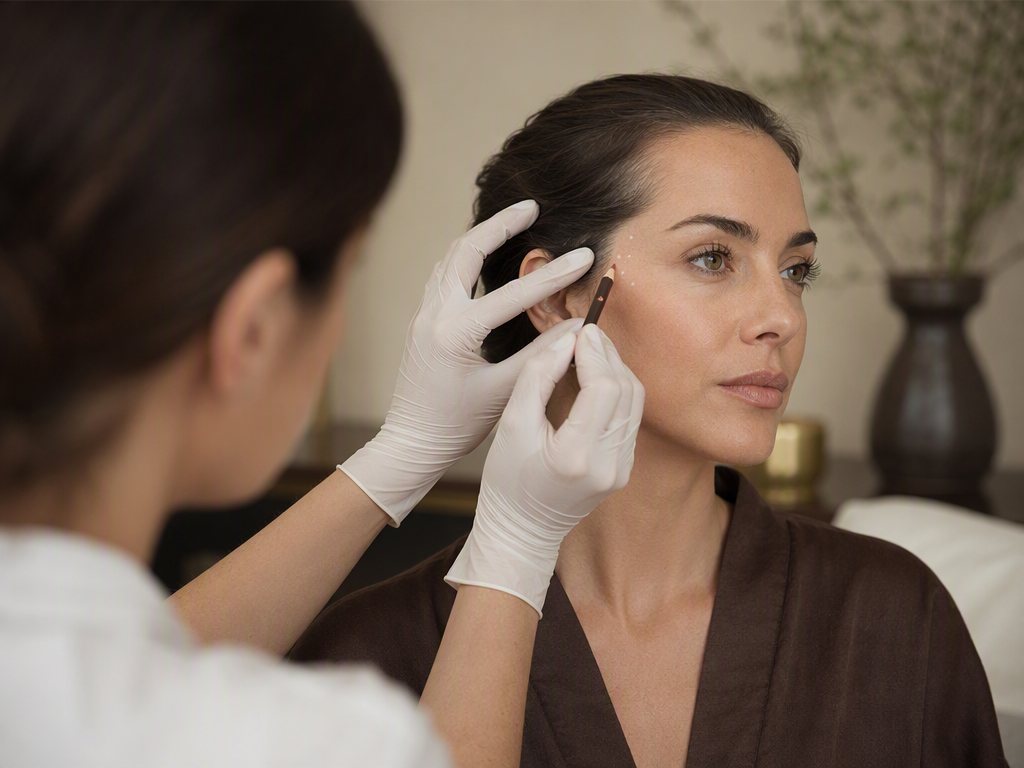
Instructions before and after CO2 laser
After CO2 laser, the quality of healing determines the quality of the result. These instructions guide you day by day and help you recognise the signs that mean you should contact Dr Yousefpour. They complement the personalised protocol Dr Yousefpour gives you.
What is normal
- A burning, sunburn-like sensation, mainly in the first few hours and for 24 to 48 hours.
- Swelling, especially of the eyelids and cheeks, often most marked between days 1 and 3.
- Temporary oozing, then fine brownish micro-crusts from day 3, which fall off on their own within 7 to 10 days.
- Itching during healing, often around day 2 or 3.
- Pink skin after the crusts fall, which can last from four weeks to three months.
- Sometimes a few small white bumps (milia) or spots, usually temporary.
After the session, step by step
- The same day
- Start the vinegar-water compresses 2 hours after the session (see below), then apply the prescribed healing balm generously: the skin should never dry out. For pain, take paracetamol rather than aspirin.
- The following nights
- Sleep with your head slightly raised, on a clean pillowcase, to limit swelling.
- Days 1 to 7
- Vinegar-water compresses 4 to 6 times a day: 1 teaspoon (5 ml) of plain white vinegar in 500 ml of water, which you can prepare in advance and keep in the fridge. Soak a clean gauze pad, wring it out, lay it on the skin for 10 to 15 minutes, then pat dry with a clean gauze pad and reapply the balm. Once healing has begun, cleanse gently with the prescribed mild cleanser. Do not scratch or pick the crusts.
- Until healed (7 to 10 days)
- No sport, sauna, steam room, swimming pool or activity that makes you sweat. Avoid bending over for long or lifting heavy loads in the first few days. Stay out of the sun; outdoors, wear a wide-brimmed hat and sunglasses.
- Around days 6 to 10
- The crusts fall off. Once the skin is closed, smooth and pink, stop the compresses and switch from balm to a gentle moisturiser, and start mineral SPF 50+ sun protection.
- From day 8
- Mineral make-up or medical camouflage is possible, only if the skin has fully healed and with Dr Yousefpour’s agreement.
- For at least 3 months
- No direct sun exposure. Mineral SPF 50+ every day, reapplied every two hours outdoors, with a hat and sunglasses. This is the best way to prevent brown marks.
- After 4 to 6 weeks
- Superficial hyaluronic acid injections can be considered. Restart retinoids, exfoliating acids and peels only with Dr Yousefpour’s agreement.
What to avoid while healing
- Picking, scratching or rubbing the crusts: they must fall off on their own. Picking them increases the risk of scarring.
- Over-the-counter antibiotic creams, particularly those containing neomycin or bacitracin, which often cause contact allergy.
- Products that were not prescribed: scented creams, essential oils, "natural" products, scrubs.
- Cortisone cream without medical advice.
- Touching your face with unwashed hands.
In the following weeks and months
- The skin keeps remodelling for 3 to 6 months: softening of wrinkles and improvement in texture progress during this time.
- Temporary brown marks can appear, especially on darker skin or after sun exposure. Report them: suitable treatment can be prescribed.
- Redness lasting beyond 3 to 6 months, or an area that stays red, thick or raised, should be shown at the practice.
Before the session
- Mention any history of cold sores (herpes): preventive antiviral treatment, started the day before, may be prescribed.
- Mention isotretinoin (Roaccutane® or similar) taken in the last 6 to 12 months, pregnancy or breastfeeding, a history of keloids or poor healing, or a skin infection.
- Avoid tanning and sun before the session, and do not plan any sun exposure in the three months afterwards.
- Depending on your skin, a depigmenting and antioxidant preparation may be prescribed about a month beforehand. Mention your usual creams (retinoids, exfoliating acids): Dr Yousefpour will tell you when to stop them.
- Come with a clean face and no make-up, wearing clothing that opens at the front, and bring a hat and sunglasses for the journey home.
- If you are given a sedative at the practice, arrange for someone to take you home.
Contact Dr Yousefpour straight away if
Infection is the main cause of scarring after laser treatment. It treats well when recognised early, usually in the first few days.
- Pain increases after the second or third day, instead of easing.
- Yellow or honey-coloured crusts, pus, small white spots or heavy discharge appear.
- You have a fever or chills.
- Small blisters or raw spots appear and spread, especially around the mouth: this may be a herpes flare.
- One area heals clearly more slowly than the rest, or intense itching persists with spreading redness.
Message Dr Yousefpour on WhatsApp the same day, with a photo if possible. If you have eye pain, a change in vision after treatment around the eyes, or a high fever with feeling unwell, go to the emergency department.
These instructions are general information. The personalised protocol Dr Yousefpour gives you at the practice always takes precedence. For any question, message Dr Yousefpour on WhatsApp.