
Wisdom teeth: should they come out? Age, surgery and day-by-day recovery
Wisdom teeth: when to remove them, at what age, under which anaesthetic, what the days after surgery are like and when to be concerned.
By Dr Afshin Yousefpour, oral and maxillofacial surgeon, Consultant Specialist (UK), FRCSEd · Published on 10 November 2026. See his background
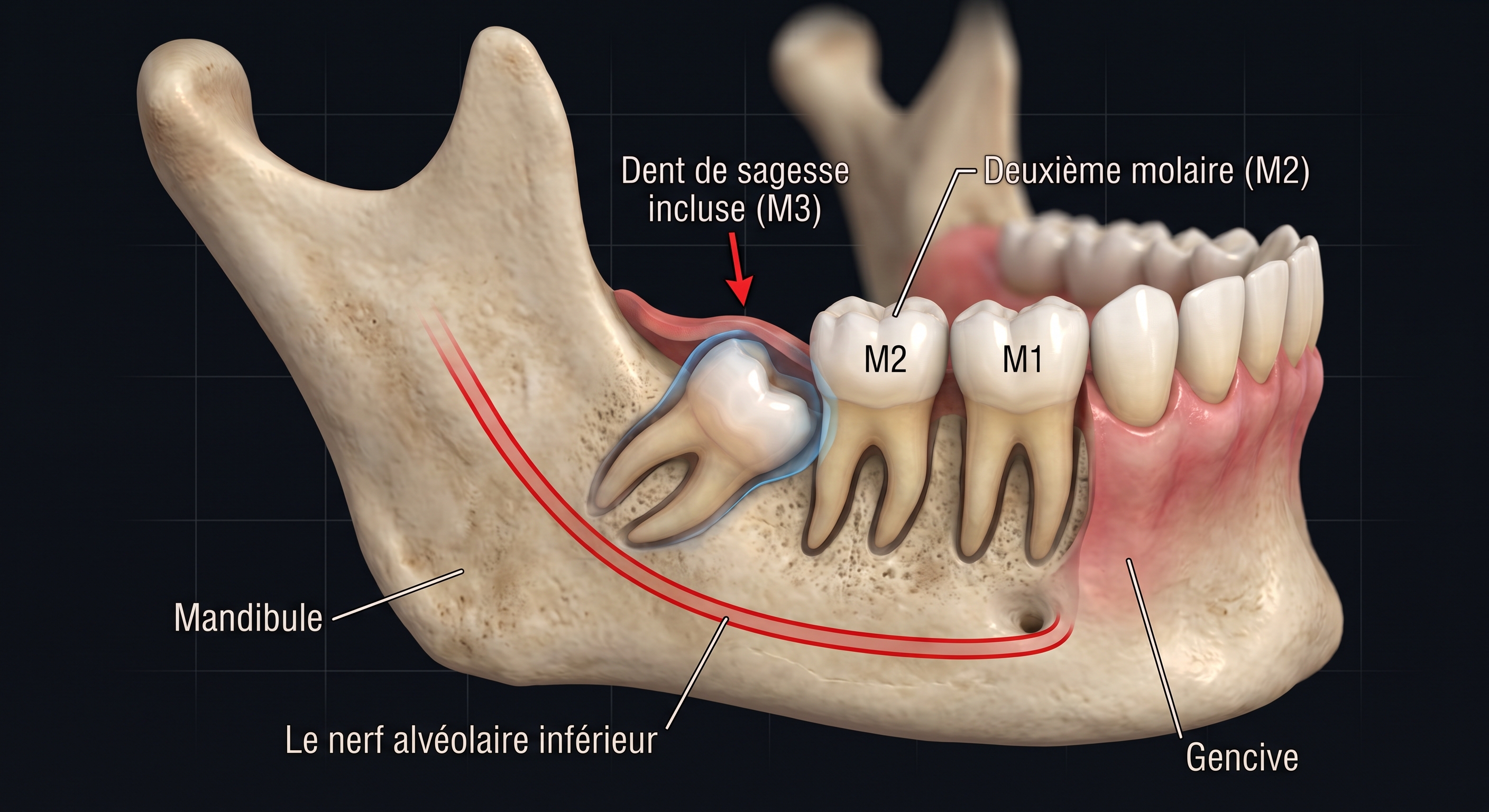
Wisdom teeth are the last teeth to come through, at the back of the mouth, in the late teens. In many people there is not enough room and they stay stuck in the bone: these are impacted wisdom teeth. Does that mean they always have to come out? At what age? And what are the days after surgery like? Here are some guidelines.
Do wisdom teeth always need to be removed?
No. A wisdom tooth that is well positioned, healthy and that you can brush properly can stay. An impacted wisdom tooth that causes no symptoms and shows no abnormality on the X-ray can also simply be monitored. The decision is made case by case, after an examination and an X-ray.
Removal is, however, advised in the following situations:
- repeated infections of the gum covering the tooth (pericoronitis): pain, swollen gum, sometimes a swollen cheek, limited mouth opening;
- decay in the wisdom tooth or in the molar it is stuck against;
- a wisdom tooth growing towards the cheek, causing irritation and inflammation;
- a cyst or another lesion around the tooth;
- gum disease around the neighbouring molar, kept going by a tooth that cannot be cleaned;
- a request from your orthodontist or dentist, to create space or reduce the risk of relapse after treatment;
- before jaw surgery, so that it can be done with less risk.
At what age should they come out?
Most often, extraction is done in the late teens or in young adults. At this age, the roots are not yet fully formed and the bone is more flexible: surgery is generally simpler and recovery quicker.
But there is no upper age limit. A wisdom tooth that is causing problems can be removed at any age. In older adults the bone is denser and recovery may take a little longer, which is taken into account in the planning.
The assessment before extraction
At the consultation, Dr Yousefpour examines your mouth and a panoramic X-ray shows the position of each tooth. When the roots of a lower wisdom tooth are close to the inferior alveolar nerve, which gives feeling to the lower lip and chin, or an upper wisdom tooth is close to the sinus, a 3D scan (CBCT) is taken at the practice to locate the tooth precisely.
If the roots touch the nerve, it is possible to remove only the crown of the tooth and leave the roots in place: this is a coronectomy. It reduces the risk of altered sensation in the lip.
Which anaesthetic?
| Option | For whom? |
|---|---|
| Local anaesthetic | One or two shallow teeth, patient at ease |
| Intravenous sedation | Anxious patient, several teeth, you stay relaxed and drowsy |
| General anaesthetic | Deeply impacted teeth, all four teeth in one session, severe anxiety |
The choice is discussed at the consultation, depending on the difficulty, the number of teeth to remove and your wishes. After sedation or a general anaesthetic, an adult must take you home and stay with you for at least 24 hours.
The operation
| In practice | |
|---|---|
| Duration | 30 to 90 minutes, depending on the number of teeth and their position |
| Hospital stay | Day case: you go home the same day |
| Stitches | Dissolvable, they disappear on their own within three weeks |
| Time off | Usually allow one week |
The gum is opened, the bone covering the tooth is removed if needed, and the tooth is often divided into pieces so it can be removed without force. Where it is justified (deep tooth, roots against the nerve, upper tooth close to the sinus), Dr Yousefpour uses piezosurgery: ultrasound cuts the bone selectively and spares the gum, blood vessels and nerve. The aim is to remove as little bone as possible, to limit swelling and pain.
Recovery day by day
| Period | What is normal | What to do |
|---|---|---|
| The same day | Light bleeding, numbness that wears off within a few hours | Bite on a gauze pad, cold pack on the cheek, do not spit or rinse, avoid hot food |
| Days 1 to 3 | Swelling and pain at their peak, limited mouth opening, sometimes bruising on the cheek | Painkillers and anti-inflammatories as prescribed, soft and semi-liquid food, rest, no sport |
| Days 4 to 7 | Swelling goes down clearly, chewing becomes more comfortable | Mouthwash and gentle brushing, gradual return to a normal diet |
| After one week | Back to work or school in most cases | Resume sport as comfort allows |
| 3 to 4 weeks | The stitches have gone, the wounds have closed | Routine follow-up appointment to check healing |
Lower wisdom teeth usually cause more swelling and limited opening than upper ones.
What to eat, and what to avoid
- The first 24 hours: lukewarm or cold food, no hot drinks, do not spit or rinse your mouth, so that the blood clot stays in place.
- The following days: soft and semi-liquid food (soup, mash, yoghurt, stewed fruit, well-cooked pasta) until chewing is comfortable again.
- No smoking: smoking clearly increases the risk of dry socket and infection.
- Hygiene: mouthwash as prescribed and brushing your other teeth from the next day, gently near the wounds.
When should you contact Dr Yousefpour?
Some signs are not normal and mean you should get in touch quickly:
- pain that increases sharply around the second or third day, when it had been easing: often a dry socket, when the blood clot comes away and leaves the bone exposed. It is very painful but treats well;
- swelling that gets worse after 4 to 5 days, with increasingly limited mouth opening: this may be an infection, which needs antibiotics and close follow-up;
- bleeding that does not stop despite biting firmly on a gauze pad for half an hour;
- a lip or chin that stays numb beyond the day after surgery;
- after removal of an upper tooth, fluid passing from the mouth into the nose.
Reimbursement
Wisdom tooth removal is a functional procedure, with a contribution from your health insurance fund (mutuelle). The breakdown of costs is given to you in writing before any decision.
Frequently asked questions
Can all four wisdom teeth be removed at once? Yes, this is common. It avoids several operations and several recovery periods. Depending on the difficulty, the procedure is then often done under sedation or a general anaesthetic.
Does it hurt? Not during the procedure: the area is numbed. Afterwards, pain depends on how difficult the extraction was. It is usually well controlled with the prescribed painkillers and anti-inflammatories, and eases as the days go by.
How much time off should I plan? Usually one week. Schedule the procedure before a quiet period rather than just before an exam or an important event.
Can my dentist or orthodontist refer me? Yes. The timing of the extraction is then coordinated with your treatment, a report is sent to them and you go back to them once healing is complete.
How long is the wait for an appointment? Except for urgent cases, you are offered an appointment within three weeks, at Face Clinic in Waterloo or at Delta Hospital in Brussels.
In summary
- A healthy, well-positioned wisdom tooth can stay; an impacted tooth with no symptoms can be monitored.
- Removal is advised for repeated infections, decay, a cyst or at the orthodontist’s request.
- It is often simpler in young adults, but possible at any age.
- Surgery takes 30 to 90 minutes, as a day case, under local anaesthetic, sedation or general anaesthetic.
- Swelling peaks in the first three days; allow one week off.
All the information on the procedure, its risks and aftercare is on the Wisdom teeth page.
This article is general information. Only a consultation can determine the right treatment for your situation.