
Laser frenectomy: tongue-tie and lip-tie, what are the benefits?
Laser frenectomy for a tongue-tie or lip-tie: when to treat, the benefits of laser over a scalpel, what happens on the day and recovery.
By Dr Afshin Yousefpour, oral and maxillofacial surgeon, Consultant Specialist (UK), FRCSEd · Published on 22 November 2026. See his background
A tongue frenulum that is too short, a lip frenulum that runs down between the front teeth: these small folds of lining can get in the way of speech, chewing, breastfeeding or orthodontic treatment. A frenectomy releases them. At the practice in Waterloo, Dr Yousefpour usually performs it with a laser. Here is when it helps, what the laser changes and what to expect on the day and afterwards.
What is an oral frenulum?
A frenulum is a fold of lining that links a moving part of the mouth to a fixed one:
- the tongue frenulum links the underside of the tongue to the floor of the mouth;
- the upper lip frenulum links the upper lip to the gum, between the central incisors;
- the lower lip frenulum links the lower lip to the gum of the lower incisors.
Everyone has frenula. They only cause problems when they are too short, too thick or attached too close to the teeth, to the point of restricting movement or pulling on the gum.
When should a tongue-tie be treated?
A short tongue frenulum has a medical name: ankyloglossia, or tongue-tie. The tongue struggles to lift towards the palate or to stick out, and its tip sometimes looks heart-shaped when pushed forward.
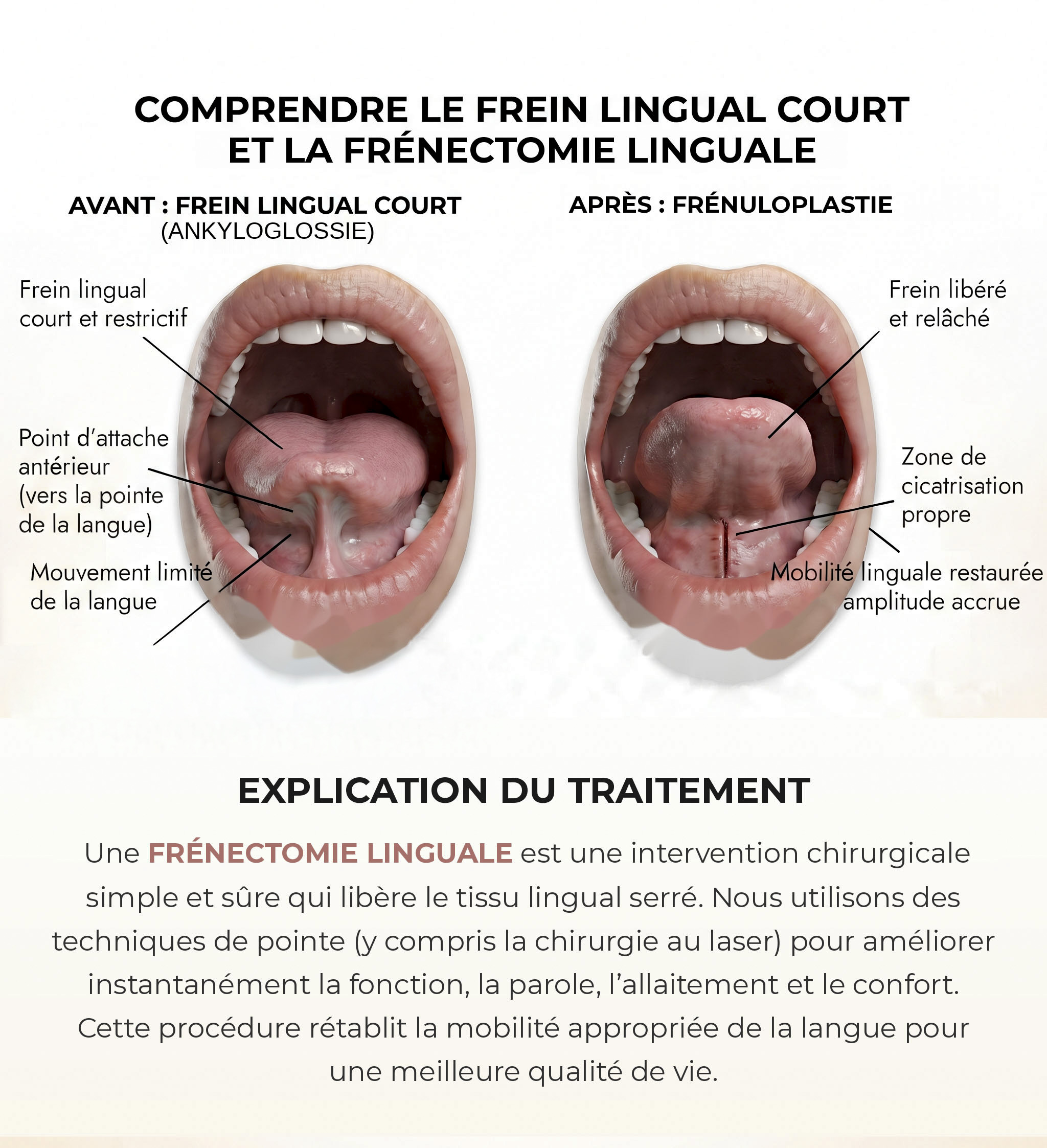
Tongue frenectomy: before, the short frenulum attached near the tip limits tongue movement; after, the tongue moves freely again.
A frenectomy is considered when the frenulum has real consequences:
- in babies, difficulties with sucking and breastfeeding;
- in children, trouble pronouncing certain sounds, together with the speech therapist;
- in adults, difficulty speaking, swallowing or chewing, or tension under the tongue.
A visible frenulum that causes no functional problem does not necessarily need surgery: the decision is always based on an assessment of tongue movement.
When should a lip-tie be treated?
The upper lip frenulum is the best-known cause of a gap between the front teeth: when it runs low between the central incisors, it can keep the space (the diastema) open, prevent it from closing, or make it reopen after orthodontics.
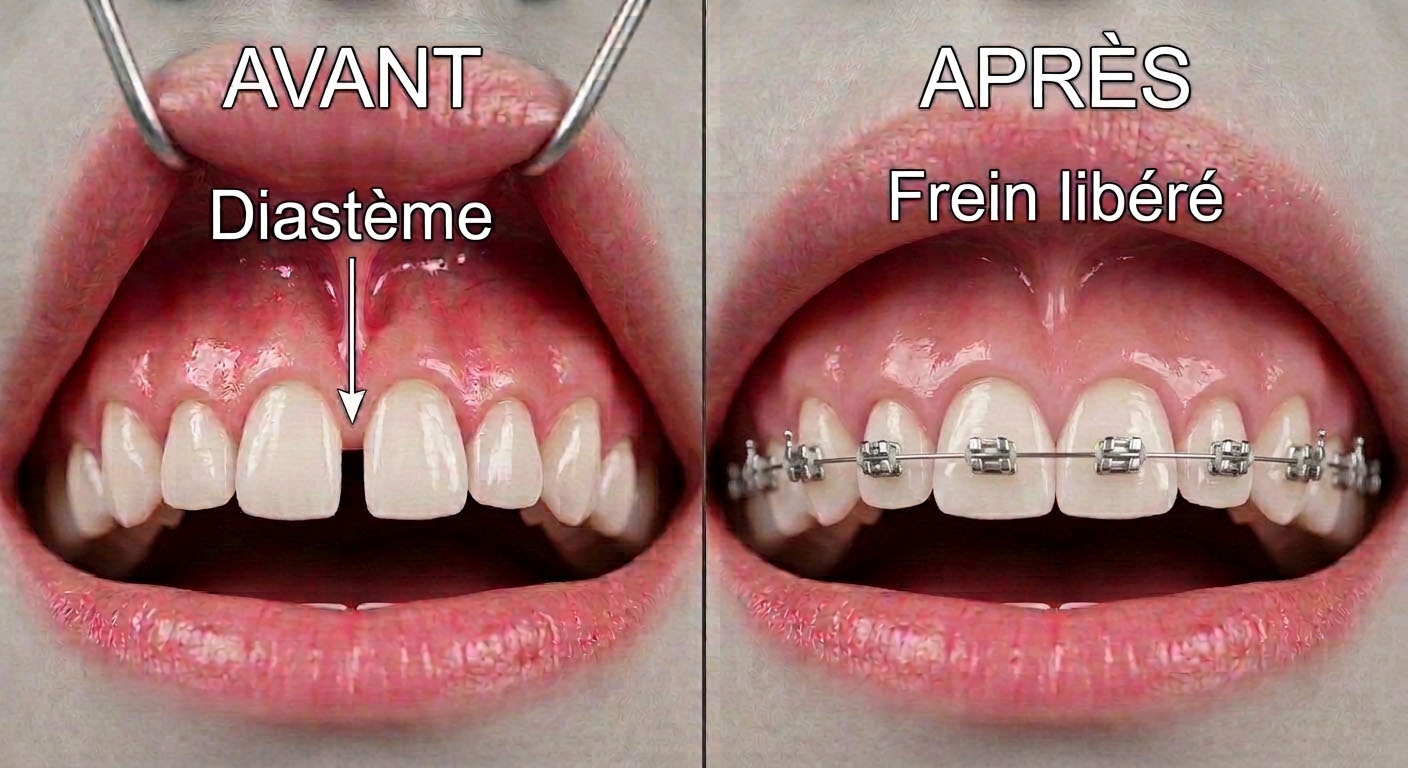
Upper lip frenectomy: once the frenulum is released, the orthodontist can close the space between the incisors.
It is also treated when it pulls on the gum enough to encourage recession, or affects the smile or the stability of a denture. For a diastema, the timing is often chosen with the orthodontist.
Why a laser rather than a scalpel?
A frenectomy can be done with a scalpel, scissors or a laser. Studies comparing these techniques find less bleeding during the procedure and less pain in the following days with the laser, for a comparable functional result. In practice, the laser offers:
- minimal bleeding: the beam seals small vessels as it cuts;
- few or no stitches, so less pulling and no stitches to remove;
- high precision, sparing the surrounding tissue;
- an area decontaminated during the procedure;
- less pain and swelling afterwards, in most cases;
- supple healing, which preserves the movement of the tongue or lip.
The laser is not a universal solution: some complex anatomies need a frenuloplasty, a lengthening of the frenulum with a plasty (a Z-plasty, for example). The technique is chosen at the consultation.
What happens on the day?
- The consultation: examination of the tongue or lip and of function (speech, swallowing, chewing) and, if needed, coordination with the orthodontist or speech therapist.
- The procedure: under gentle local anaesthesia, it takes 15 to 30 minutes as a day case. For an anxious child, sedation or general anaesthesia in hospital is possible.
- The check-up: a follow-up visit confirms healing and recovery of movement.
Recovery and healing
Mild discomfort for 24 to 48 hours is usual and is controlled with ordinary painkillers. From the first day, a thin whitish film covers the area: this is the healing membrane typical of laser treatment, not an infection. It should not be removed. The lining has usually healed within 7 to 10 days.
The stretching exercises matter as much as the procedure itself: 3 to 4 times a day for about 2 weeks, they stop the frenulum from re-forming as it heals. For a tongue-tie, a speech therapist often supports the rehabilitation. Detailed instructions (lukewarm soft food, gentle brushing, no smoking and no straws) are given after the procedure.
Frequently asked questions
Does a laser frenectomy hurt? Not during the procedure, thanks to local anaesthesia. Afterwards, mild discomfort lasts a day or two.
Are stitches needed? With the laser, few or no stitches are needed, depending on the frenulum and the technique chosen.
Can the frenulum re-form? It can if healing is not guided. The prescribed exercises greatly reduce this risk.
Can my orthodontist refer me? Yes, this is common for a diastema. Dr Yousefpour performs the frenectomy and the orthodontist continues the treatment.
In short
- A tongue-tie or lip-tie is only treated if it causes a real problem.
- A short tongue frenulum affects speech, swallowing or breastfeeding; a low lip frenulum often keeps a diastema open.
- The laser limits bleeding, stitches and discomfort after the procedure.
- The procedure takes 15 to 30 minutes, under local anaesthesia, as a day case.
- Exercises afterwards are the key to a lasting result.
Everything about the procedure is on the Laser frenectomy page. To book in Waterloo or Brussels, send a WhatsApp message to the practice.
This article is general information. Only a consultation can determine the right treatment for you or your child.